
When you’re shopping for home insurance, you might worry that getting a quote will hurt your credit score. You’ve heard stories about lenders pulling your credit and seen your score drop after applying for a loan. So naturally, you wonder: do home insurance quotes run your credit? The short answer is usually no-but there’s more to it than that.
Most home insurance quotes use a soft inquiry, not a hard pull
Insurance companies don’t check your credit the same way a bank does. When you apply for a mortgage or credit card, the lender makes a hard inquiry-a formal check that shows up on your credit report and can lower your score by a few points. Home insurers, on the other hand, typically run a soft inquiry. This is a background check they use to assess risk, but it doesn’t affect your credit score at all. You won’t see it listed as a loan or credit application. It’s invisible to lenders and doesn’t show up when you check your own report through services like Equifax or Experian.In Australia, insurers like Allianz, NRMA, and Suncorp use credit-based insurance scores to help predict how likely someone is to file a claim. But this isn’t the same as evaluating your ability to repay debt. It’s more about patterns-like whether you’ve paid bills on time, how often you’ve had late payments, or if you’ve had accounts sent to collections. They’re not looking at your income or debt-to-income ratio. They’re looking for signs of financial responsibility.
Why do insurers check credit at all?
It might seem unfair-why should your credit history affect your home insurance price? But insurers aren’t trying to punish you. They’re trying to predict risk. Studies by the Consumer Federation of America and Australia’s Australian Prudential Regulation Authority (APRA) have found a statistical link between credit history and insurance claims. People with lower credit-based insurance scores tend to file more claims, even when you control for things like home age or location.This isn’t about whether you’re good with money. It’s about behavior. Someone who consistently pays their phone bill late might also be more likely to delay fixing a leaky roof. Someone who’s had multiple bankruptcies might be less likely to maintain their property. It’s not perfect, but it’s a tool insurers use to group similar risks together. And because of that, your quote could be higher-even if you’ve never made a claim on your home policy.
You can still get a quote without a credit check
Not all insurers use credit-based scoring. Some smaller providers, mutual insurers, or niche companies focus purely on property details: square footage, construction type, security systems, flood risk, and claims history. If you’re concerned about your credit, you can ask upfront: "Do you use credit information to determine premiums?" Some companies will tell you right away.For example, in Sydney, some local insurers like GIO and Youi offer quotes based mainly on property characteristics. They might ask for your postcode, year of build, and whether you have smoke alarms or a home alarm system-but not your credit file. You can also try bundling your home and car insurance with a provider that doesn’t rely on credit scoring. Many people don’t know this option exists.
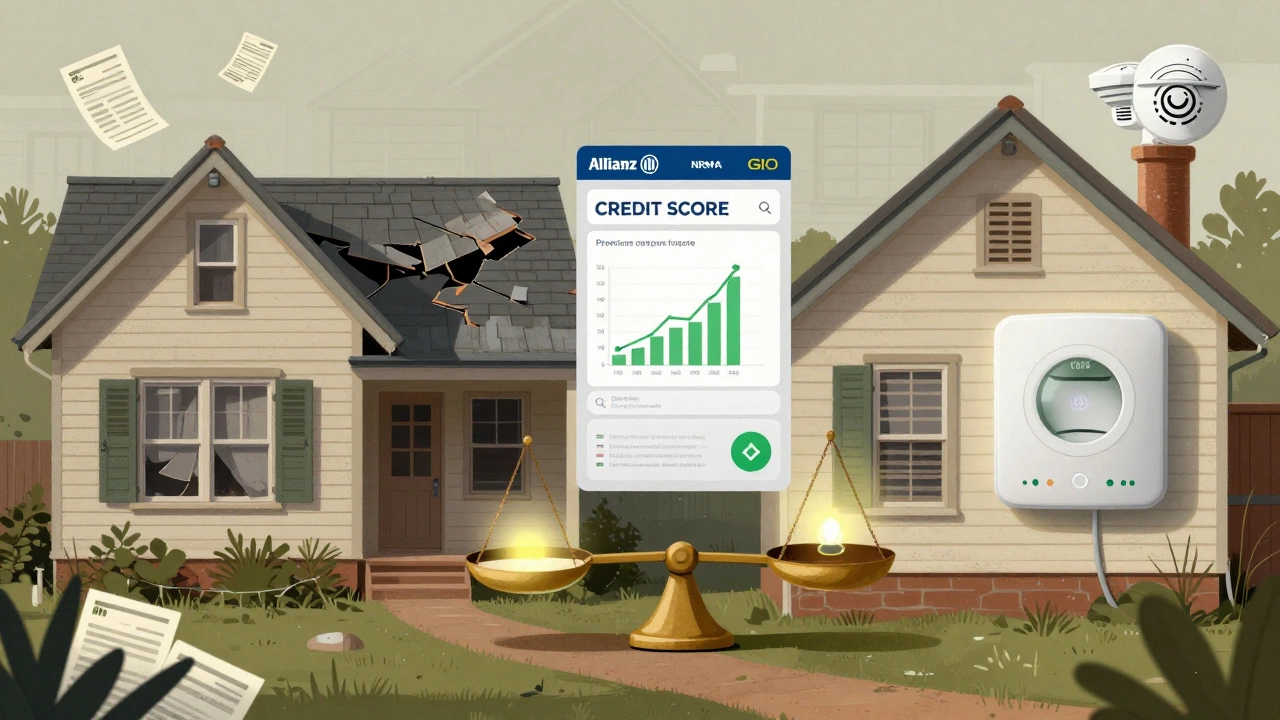
What if you have bad credit? You’re not locked out
Having a low credit score doesn’t mean you can’t get home insurance. It just means you might pay more. But you still have options.- Improve your credit score before applying. Pay down balances, fix errors on your report, and avoid opening new accounts in the 6 months before shopping for insurance.
- Ask for a manual underwriting review. Some insurers will let you explain your situation-like a medical emergency that caused missed payments-and adjust your quote accordingly.
- Compare at least three providers. One insurer’s penalty might be another’s discount. A quote from a company that doesn’t use credit scoring could save you hundreds.
- Install safety features. A monitored alarm system, fire sprinklers, or storm shutters can offset a higher premium based on credit.
In 2024, the Australian Competition and Consumer Commission (ACCC) reviewed credit-based insurance scoring and found that while it’s legal, it can disproportionately affect low-income households. That’s why some consumer advocates recommend shopping around more aggressively if your credit isn’t strong.
How to protect your credit while getting quotes
Even though soft inquiries don’t hurt your score, you can still take steps to keep your credit clean while shopping:- Get quotes within a short window-ideally 14 days. If multiple insurers run soft pulls, they’ll often be grouped as one event by credit bureaus, especially if they happen close together.
- Use online comparison tools that don’t require personal details upfront. Sites like Compare the Market or MoneySmart let you enter basic info and get estimates without submitting your name or ID.
- Don’t apply for new credit while shopping for insurance. Even a new credit card application can trigger a hard inquiry, which might confuse insurers or make you look riskier.
- Check your credit report for errors. A single late payment that’s not yours could inflate your insurance quote. You can get a free report from Equifax or Illion once a year.

What’s different in Australia?
In the U.S., credit-based insurance scoring is common and regulated at the state level. In Australia, it’s less standardized. Some insurers use it, others don’t. There’s no national law banning it, but the industry doesn’t promote it openly. You won’t find it advertised on websites. You have to ask.Also, Australian insurers can’t use your credit score to deny coverage outright. They can only adjust your premium. If you’re refused a quote, it’s because of the property-not your credit history. That’s different from the U.S., where some insurers can decline applicants based on credit.
What to do next
Don’t let fear of a credit check stop you from getting quotes. You’re not risking your score by asking. Here’s what to do right now:- Call or visit three insurers and ask: "Do you use credit information to calculate premiums?" Write down their answers.
- Use a free comparison tool like MoneySmart’s insurance calculator to get ballpark figures without sharing personal data.
- Fix any errors on your credit report before applying. A 20-point improvement could drop your premium by 10% or more.
- Don’t assume the cheapest quote is the one with the lowest credit score. Sometimes, a company that doesn’t use credit at all will give you a better deal.
Home insurance isn’t about your financial past-it’s about protecting your home today. The right policy shouldn’t punish you for past mistakes. But you won’t find it unless you ask the right questions and shop beyond the first quote you see.
Do home insurance quotes affect my credit score?
No, home insurance quotes typically use a soft inquiry, which doesn’t impact your credit score. Unlike applying for a loan or credit card, these checks are invisible to lenders and won’t lower your score.
Why do insurers check my credit if I’m not borrowing money?
Insurers use credit-based scores to predict claim risk. Studies show people with lower credit scores tend to file more claims, so insurers use this as one factor to set premiums. It’s not about your ability to pay-it’s about patterns of responsibility.
Can I get home insurance without a credit check in Australia?
Yes. Some insurers, especially smaller or local providers, base quotes solely on property details like location, construction type, and security features. You can ask directly if they use credit scoring, and many will say no.
What if I have bad credit? Will I be denied coverage?
No. Australian insurers can’t deny you home insurance based on credit alone. They can only charge a higher premium. If you’re refused, it’s because of the property’s condition or risk factors-not your financial history.
How can I lower my home insurance premium if my credit isn’t good?
Install safety features like alarms or fire sprinklers, bundle policies with a provider that doesn’t use credit scoring, fix errors on your credit report, and compare quotes from at least three insurers. One might not use credit at all.