
Crypto Tax & Visibility Checker
Enter your transaction details to see how visible your crypto activity is to the government and what steps you should take.
Analysis Results
Tax Implications
Recommended Action
You buy some Bitcoin with your credit card at 2 AM. You feel a rush of freedom. No bank manager is watching you spend that money. But here is the uncomfortable truth: the government almost certainly knows about it. If you think buying crypto means vanishing into the digital ether, you are likely mistaken. The idea that cryptocurrency is anonymous is one of the most persistent myths in modern finance. In reality, for most people using regulated exchanges, the government has a very clear line of sight into your wallet.
| Transaction Method | Government Visibility | Primary Data Source | Risk Level |
|---|---|---|---|
| Regulated Exchange (Coinbase/Kraken) | High | KYC Reports, Form 1099-DA | Low (if reported) |
| Credit Card Purchase | Medium-High | Bank Statements, Merchant Codes | Medium |
| Peer-to-Peer (P2P) Cash | Low-Medium | Exchange Logs, Bank Deposits | Medium-High |
| On-Chain Transfer | Medium | Public Ledger Analysis | Low (unless linked to ID) |
The End of Anonymity: KYC and Reporting
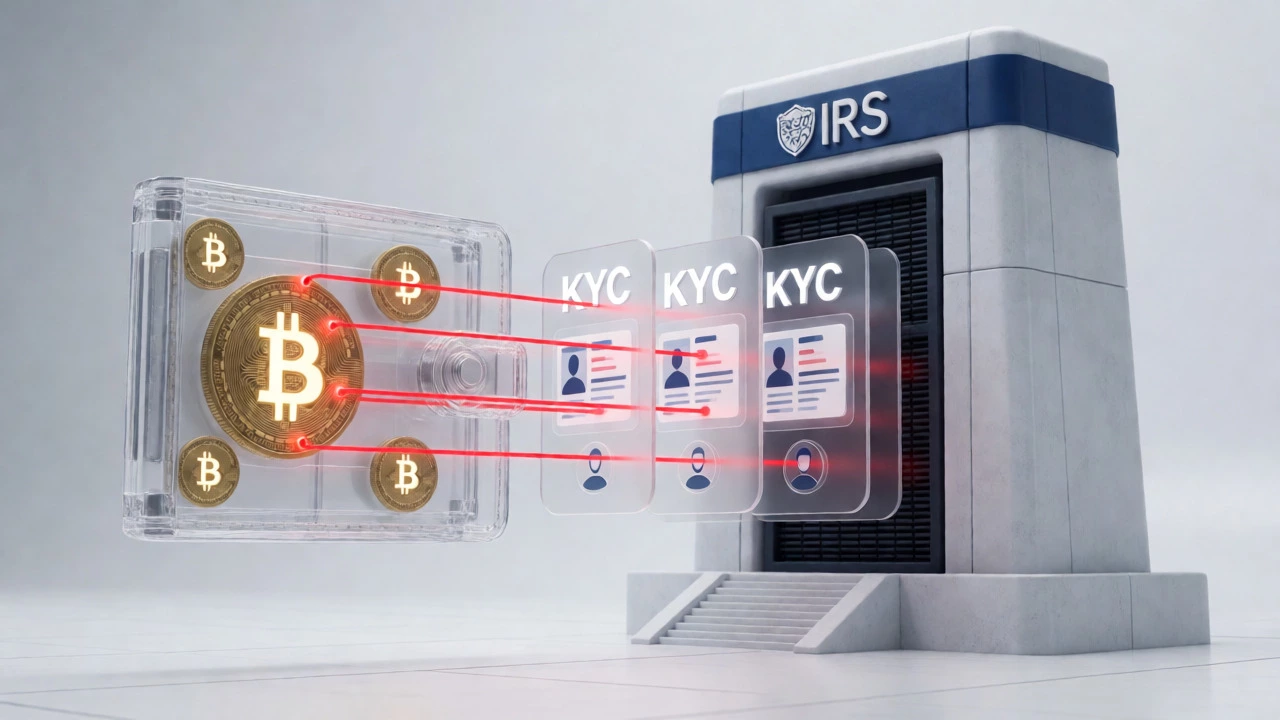
Let’s start with the biggest reason governments know about your holdings: Know Your Customer (KYC) laws. When you sign up for a major platform like Coinbase, Kraken, or Binance.US, you don’t just create a username. You upload your driver’s license, take a selfie, and provide your Social Security number or Tax ID. This isn’t optional; it’s federal law designed to stop money laundering.
Once you are verified, every single trade you make is logged. These platforms are required to report certain transactions to the Internal Revenue Service (IRS). For years, this was inconsistent, but recent legislation has tightened the screws. Starting in 2025, brokers must report gross proceeds from digital asset sales on Form 1099-DA. This form acts like a receipt for the taxman. It tells them exactly how much you sold, when you sold it, and often what you paid for it. If you bought $5,000 worth of Bitcoin and sold it for $10,000, the IRS gets a copy of that transaction before you even file your taxes.
What if you use a decentralized exchange like Uniswap? There is no central company holding your identity. However, if you funded that decentralized wallet from a centralized bank account or a regulated exchange, the link remains. The blockchain itself is not private. It is public. Anyone can see that address A sent 1 BTC to address B. If the government knows that address A belongs to you (because you withdrew from Coinbase), they know you moved that Bitcoin. They might not know who owns address B yet, but they know you own the source.
How Banks Track Crypto Purchases
Even if you avoid exchanges and buy directly from a friend, your bank might still snitch. Most traditional banks treat cryptocurrency purchases as high-risk transactions. Why? Because they involve converting fiat currency into volatile assets, which can be used to move money across borders quickly. Many banks use automated algorithms to flag merchant category codes associated with crypto merchants. If you buy Bitcoin with a Visa or Mastercard, the transaction description often reads something like "COINBASE.COM" or "CRYPTO EXCHANGE."
Your bank statement becomes a paper trail. While banks do not automatically send these specific line items to the IRS for small amounts, they retain them for years. If you get audited, the first thing an auditor will ask for is three years of bank statements. They will scan for recurring transfers to known crypto entities. Furthermore, under the Bank Secrecy Act, financial institutions must file a Currency Transaction Report (CTR) for any cash deposit or withdrawal over $10,000. If you withdraw $12,000 in cash to buy Bitcoin from a peer, that report goes straight to the Financial Crimes Enforcement Network (FinCEN). It doesn’t say you bought Bitcoin, but it says you moved large amounts of cash, which raises eyebrows.
The Blockchain Is Not Anonymous, It’s Pseudonymous
This is a distinction that trips up many new investors. Bitcoin is pseudonymous, not anonymous. Your name does not appear on the blockchain. Instead, you have a string of alphanumeric characters called a public key. To the average person, this looks random. To a forensic accountant, it is a map.
Companies like Chainalysis and Elliptic specialize in deanonymizing blockchain data. They work with law enforcement and tax agencies. Their software can cluster addresses together. If you send Bitcoin from your personal wallet to a cold storage device, and then later send it back to an exchange where you entered your name, those two wallets are now linked in their database. Over time, as more users enter the ecosystem, the web of connections grows denser. It becomes increasingly difficult to keep a wallet truly separate from your identity.
Consider a real-world scenario. You mine Ethereum on your home computer. You earn rewards into a wallet. You never interact with an exchange. For five years, the government ignores you. Then, you decide to sell. You send your ETH to a centralized exchange to cash out. At that moment, your entire history of mining rewards becomes visible. The exchange asks for your ID. Now, the government knows you held those coins for five years. If you didn’t report the income when you mined it, you might face penalties for unpaid taxes on that historical income, plus interest.
What Happens If You Don’t Report?
The IRS has made crypto a priority. Since 2014, guidance has stated that virtual currency is property, not currency. This means every sale, swap, or purchase with crypto triggers a taxable event. You owe capital gains tax on the profit. If you lose money, you can offset other gains.
If you fail to report, you rely on luck. But the net is tightening. The IRS has conducted massive campaigns sending letters to taxpayers whose trading activity on exchanges exceeded certain thresholds. These are not audits; they are warnings. They essentially say, "We see you traded $50,000 worth of crypto last year. Did you pay tax on it?" Ignoring these letters can escalate to a full audit.
Audit rates for crypto holders are rising. In recent years, the IRS has secured billions in additional funding specifically to hire agents trained in digital assets. They are not guessing anymore. They are matching data from Form 1099s against tax returns. If your return shows zero capital gains, but the exchange reports $20,000 in sales, the discrepancy flags automatically. The cost of non-compliance includes back taxes, interest, and potentially significant fines. In extreme cases of willful neglect, criminal charges are possible, though rare for average investors.
Privacy Coins and Off-Ramps
Some investors turn to privacy-focused cryptocurrencies like Monero or Zcash to hide their tracks. These coins obscure the sender, receiver, and amount on the ledger. This makes on-chain analysis much harder. However, this strategy has limits.
First, many major exchanges delist privacy coins due to regulatory pressure. You might have to use smaller, offshore exchanges to buy or sell Monero. These platforms may still require KYC, or they may operate in gray areas where banking partners pull out suddenly. Second, once you want to spend your privacy coin or convert it back to dollars, you usually have to touch the traditional financial system again. That final off-ramp is where the anonymity breaks. If you withdraw cash from an ATM using a prepaid card loaded with Monero, the ATM operator logs the transaction. If you deposit that cash into your bank, the CTR rules apply.

International Swaps and Global Standards
Crypto is global, but tax laws are national. If you live in Australia, Canada, or the UK, similar rules apply. The Financial Action Task Force (FATF) sets global standards for anti-money laundering. Countries are increasingly sharing data through frameworks like the Common Reporting Standard (CRS). If you hold crypto on a foreign exchange while living abroad, that country may report your balance to your home country’s tax authority.
For example, if you are a US citizen living in Europe and using a European exchange, the EU’s DAC8 directive aims to improve tax transparency in the crypto sector. This means data sharing between member states and potentially with third countries like the US is becoming more robust. Hiding behind a foreign exchange is no longer the safe harbor it once was.
Practical Steps to Stay Compliant
So, what should you actually do? First, assume everything is visible. Do not try to game the system with complex loops that the IRS hasn’t caught yet. Technology catches up fast.
- Keep Detailed Records: Use software like Koinly or CoinTracker. These tools connect to your exchanges and wallets via API keys. They calculate your cost basis and gains automatically. This saves you hours during tax season and provides evidence if you are audited.
- Report Everything: Even if you didn’t receive a 1099 form, report your trades. The question on the standard 1040 tax form asking "Did you sell, exchange, or dispose of digital assets?" is mandatory. Checking "No" when you did trade is technically perjury.
- Understand Cost Basis Methods: You can choose how to calculate your cost basis. FIFO (First-In, First-Out) is the default. Some advanced traders use Specific Identification, which allows you to pick which coins you sold. This requires meticulous record-keeping but can optimize your tax bill.
- Consult a Professional: If your portfolio exceeds $50,000 or involves staking, lending, or NFTs, hire a CPA who specializes in crypto. General accountants often miss nuances like staking rewards being taxed as ordinary income upon receipt.
Remember, the goal isn’t to hide from the government forever. It’s to stay compliant so you can sleep at night. The peace of mind that comes from knowing you’ve done things right is worth far more than the few hundred dollars you might save by skipping a report.
Frequently Asked Questions
Does the IRS track every Bitcoin transaction?
The IRS does not track every single on-chain transfer in real-time. However, they track transactions involving regulated exchanges that report to them via forms like 1099-DA. They also analyze blockchain data when investigating specific cases or audits. So, while they don't watch every satoshi move, they have visibility into the majority of retail investor activity.
Can I buy Bitcoin with cash without telling the government?
You can buy Bitcoin with cash from a peer or an ATM, but there are limits. ATMs often require ID verification for larger amounts. If you deposit more than $10,000 in cash into a bank to fund the purchase, a Currency Transaction Report is filed. Small cash purchases from friends are less visible, but you still owe taxes on any gains when you eventually sell.
What happens if I forget to report my crypto profits?
If you forget to report, you risk receiving a notice from the IRS demanding payment of back taxes plus interest. Penalties can apply if the omission is deemed substantial. In severe cases, ignoring notices can lead to an audit. It is always better to amend your return voluntarily if you discover an error.
Are crypto losses useful for taxes?
Yes, crypto losses can reduce your tax liability. If you sell Bitcoin for less than you paid, you realize a capital loss. This loss can offset capital gains from other investments. If your losses exceed your gains, you can deduct up to $3,000 against your ordinary income per year, carrying forward any excess to future years.
Do I need to pay taxes if I just hold Bitcoin?
Generally, no. Holding Bitcoin (HODLing) does not trigger a tax event. Taxes are typically incurred when you sell, trade, or spend your crypto. However, if you earn rewards through staking or lending, those rewards are often considered taxable income at the moment you receive them, regardless of whether you sell them.