
Bad Credit Loan Cost Calculator
Enter your loan details below to see how much you will actually pay back for different types of bad-credit loans.
Typical Rate: 90% APR
$0.00
$0.00
$0.00
Fee: $15 per $100 (2 weeks)
$0.00
$0.00
~400%
Tip/Subscription Model
$0.00
$5.00
$0.00
You’re staring at a bill that’s due in 48 hours. Maybe it’s a car repair you can’t ignore, or a medical copay that slipped through the cracks. You need $1000 right now, but your credit score isn’t exactly helping you out. The bank says no. Your credit card is maxed. Panic starts to set in.
Here’s the good news: you have more options than you think. Borrowing small amounts quickly doesn’t require perfect credit anymore. In fact, many lenders specialize in helping people just like you get access to cash without pulling their credit history apart. But not all options are created equal. Some will save you money; others will trap you in a cycle of debt for months.
This guide cuts through the noise. We’ll look at the fastest ways to get $1000 in hand when you have bad credit, what each option actually costs you, and how to avoid the traps that catch most borrowers off guard.
The Reality of Small Emergency Loans
When you need a small amount like $1000, traditional banks often aren’t an option. They prefer larger loans where the administrative cost per dollar borrowed makes sense. For them, processing a $1000 loan takes almost as much work as a $10,000 loan, but yields far less profit. So they pass on you.
Instead, you’re looking at alternative lenders. These fall into three main buckets: online installment lenders, cash advance apps, and peer-to-peer platforms. Each has different speed, cost, and qualification profiles. Understanding these differences is key to choosing the right one for your situation.
Bad Credit Loans are designed specifically for borrowers with scores below 670. Unlike standard personal loans, these often rely on income verification rather than credit history alone. This opens doors for people who’ve had past financial hiccups but currently have steady cash flow.
Option 1: Online Installment Lenders (Best Balance)
If you can wait 24-48 hours, online installment lenders are usually your best bet for $1000. Companies like Upstart, Avant, or LendingPoint use algorithms that look beyond your FICO score. They consider your education, job stability, and banking history.
Why choose this route? Because the interest rates, while higher than prime loans, are significantly lower than payday loans. A typical APR might range from 30% to 150%, depending on your risk profile. More importantly, you repay over several months, which keeps monthly payments manageable.
For example, if you borrow $1000 at a 90% APR over 6 months, your monthly payment would be roughly $210. That’s painful but doable if you budget carefully. Compare that to a payday loan requiring full repayment in two weeks, and the difference becomes stark.
Pro tip: Check pre-qualification offers first. Most reputable online lenders let you see your potential rate without affecting your credit score. This soft pull lets you compare options risk-free.
Option 2: Cash Advance Apps (Fastest Access)
Need the money today? Cash advance apps like Earnin, Dave, or Brigit have exploded in popularity. They connect to your checking account via secure APIs and analyze your spending patterns and direct deposit history. If you have regular income hitting your account, you can often access up to $500 immediately, sometimes more.
These aren’t technically “loans” in the traditional sense. Many operate on a tip-based model or charge a small subscription fee. There’s rarely a hard credit check. Approval is nearly instant, and funds hit your account within minutes or hours.
However, limits are low. Getting $1000 in one go might require using multiple apps or having a strong history with one provider. Also, watch out for hidden fees. While some advertise “no interest,” they may charge expedited transfer fees ($2-$10) or membership fees ($1-$5/month). Over time, these add up.
Use this option only if you’re certain you can repay by your next paycheck. It’s excellent for bridging a short gap, not for long-term debt management.
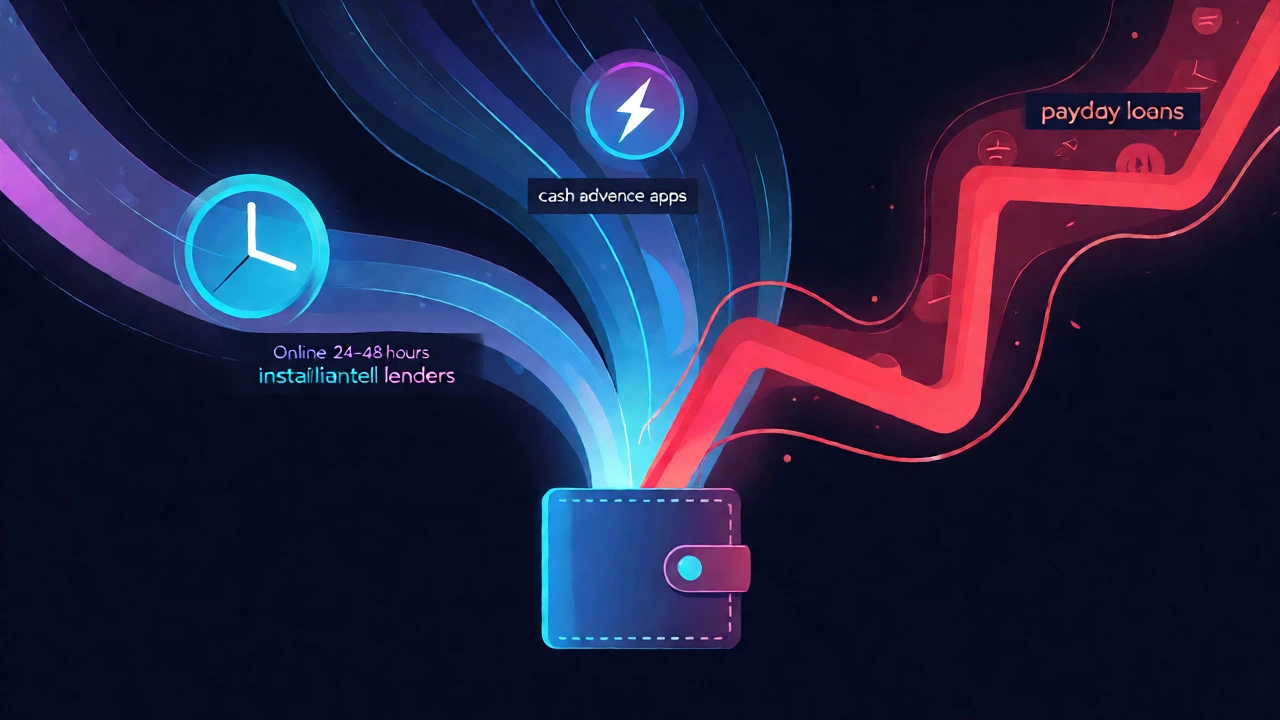
Option 3: Payday Loans (The Last Resort)
Payday loans are notorious for high costs, but they remain widely available. You write a post-dated check or authorize an electronic debit for the loan amount plus fees, typically due on your next payday.
The math here is brutal. A common fee structure is $15 per $100 borrowed. On a $1000 loan, that’s $150 in fees for just two weeks. If you roll it over because you can’t pay it back, another $150 gets added. Two rollovers, and you’ve paid $450 in fees on a $1000 loan. That’s equivalent to an APR of nearly 400%.
Despite the reputation, payday loans serve a purpose. They provide immediate liquidity when no other option exists. Just ensure you understand the total cost before signing. And never take out a new payday loan to pay off an old one unless absolutely necessary-it’s a slippery slope.
| Loan Type | Speed of Funds | Credit Check | Typical Cost (APR/Fees) | Repayment Term |
|---|---|---|---|---|
| Online Installment Loan | 1-2 Business Days | Soft Pull (Pre-qualify) | 30%-150% APR | 3-24 Months |
| Cash Advance App | Instant - 24 Hours | No Hard Pull | Tips + Transfer Fees | Next Paycheck |
| Payday Loan | Same Day | Minimal/None | ~400% APR Equivalent | 2 Weeks |
| Secured Credit Card | 1-3 Days | Yes (Often Lenient) | 20%-25% APR | Revolving |
Hidden Costs and Traps to Avoid
Lenders targeting bad credit borrowers know urgency drives decisions. They count on you skipping the fine print. Here’s what to watch for:
- Origination Fees: Some online lenders deduct 1%-8% of the loan amount upfront. If you borrow $1000, you might receive only $920 but owe $1000 plus interest.
- Affinity Marketing: Be wary of sites that claim to be direct lenders but are actually brokers selling your info to dozens of lenders. You might end up with worse terms than you could find yourself.
- Auto-Renewals: Subscription-based apps may auto-renew monthly fees even after you stop using the service. Cancel explicitly if you don’t plan to keep using it.
- Bank Overdrafts: If your repayment fails, your bank might charge an overdraft fee ($35+) on top of the lender’s late fee. Set aside buffer funds in your account before the due date.
Always calculate the Total Cost of Borrowing. Add up every fee, interest payment, and penalty. Divide by the principal amount. If the result exceeds 50% of the loan value for a short-term loan, reconsider whether the emergency is worth the financial damage.

Steps to Secure Your 00 Quickly
Don’t just apply randomly. Follow this checklist to maximize approval odds and minimize costs:
- Gather Documents: Have your ID, recent pay stubs (last 30 days), and bank statements ready. Even if lenders say “no docs needed,” having them speeds up verification.
- Check Pre-Qualification: Visit 2-3 reputable online lender websites. Use their pre-qualification tools to see estimated rates without impacting your credit.
- Compare Offers Side-by-Side: Look at the APR, origination fees, and monthly payment. Ignore marketing claims like “low monthly payments” if the term is stretched too long.
- Read the Fine Print: Specifically look for early repayment penalties. Ideally, you want a loan you can pay off early without extra charges.
- Apply During Business Hours: Submit applications between 9 AM and 3 PM local time. This increases the chance of same-day review and funding.
- Verify Bank Details: Ensure the routing and account numbers match exactly. Errors here delay deposits by days.
Beyond the Loan: Preventing Future Emergencies
Borrowing $1000 solves today’s problem, but it doesn’t fix tomorrow’s. If you find yourself needing quick cash repeatedly, it’s a sign your budget needs adjustment.
Start building a micro-emergency fund. Aim for $500 initially. Keep it in a separate savings account linked to your checking account for easy transfers. Every time you skip a non-essential purchase-like a coffee run or streaming subscription-transfer that money into this fund.
Also, negotiate bills. Call your internet provider or insurance company. Ask for a lower rate. Often, threatening to cancel triggers a retention offer. Saving $20/month adds up to $240/year-almost half of your emergency loan.
Finally, consider side income. Platforms like TaskRabbit, Uber, or freelance sites can generate $100-$200 in a weekend. This reduces reliance on debt for future shocks.
Can I get a $1000 loan with a credit score under 500?
Yes, but options narrow significantly. You’ll likely face higher interest rates or shorter terms. Secured loans, where you put up collateral like a car title or savings account, become more accessible. Payday loans and cash advance apps also approve very low scores since they focus on income rather than credit history.
How fast can I actually get the money?
Cash advance apps can provide funds instantly or within a few hours. Payday lenders often offer same-day funding if you apply early in the day. Online installment loans typically take 1-2 business days, though some providers offer expedited transfers for a fee, delivering funds within 24 hours.
Will borrowing $1000 hurt my credit score?
It depends. Pre-qualification checks usually involve a soft inquiry, which doesn’t affect your score. However, once you accept a loan, the lender may perform a hard inquiry, temporarily dropping your score by a few points. Late payments will hurt more. Timely repayments, conversely, can help build your credit over time.
What happens if I miss a payment?
Consequences vary by lender. Payday lenders may automatically debit your account, potentially causing overdraft fees. Online installment lenders might charge late fees (often $15-$30) and report delinquency to credit bureaus after 30 days. Always communicate with your lender if you anticipate missing a payment; some offer grace periods or payment plans.
Are there alternatives to taking out a loan?
Absolutely. Consider selling unused items on Facebook Marketplace or eBay. Ask family or friends for a short-term gift or loan (put it in writing to avoid awkwardness). Negotiate payment plans directly with creditors, such as hospitals or utility companies, which often waive fees for setting up installments.