
Homeowners Insurance 80% Rule Calculator
Enter your policy details below to check if you meet the 80% threshold and calculate your expected payout for a specific claim.
Imagine this: a severe storm tears the roof off your home. You file a claim, expecting your insurer to cover the full cost of repairs. Instead, they tell you that because your house is worth more than what you declared on your policy, you only get paid for a portion of the damage. This isn't a trick; it's the 80 rule in action. If you don't understand how this mechanism works, you could be paying for full coverage while actually being significantly underinsured.
The 80% rule is a standard clause found in most homeowners insurance policies. It requires you to insure your home for at least 80% of its current replacement cost to receive full benefits when a partial loss occurs. If you fall below this threshold, your payout is calculated using a specific formula that reduces your compensation. For many homeowners, this creates a hidden financial trap that only becomes visible after a disaster strikes.
What Exactly Is the 80% Rule?
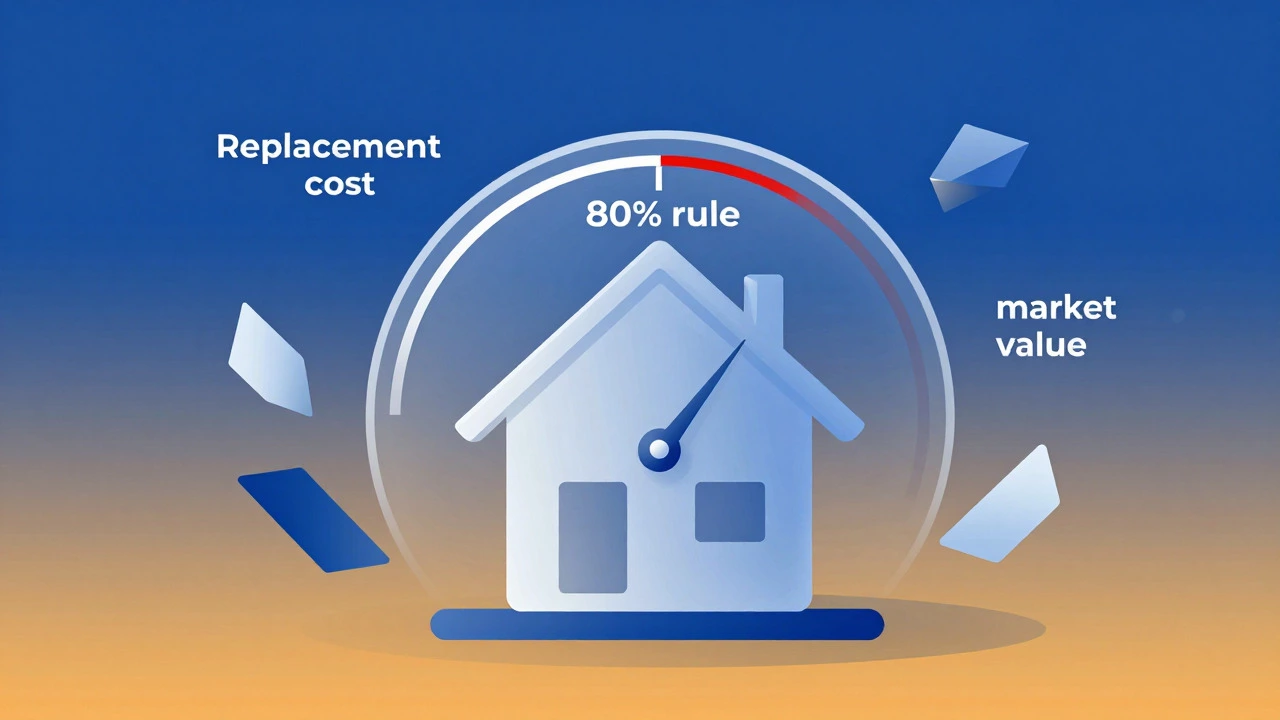
The 80% Rule is a provision in homeowners insurance that mandates policyholders maintain dwelling coverage equal to at least 80% of the home's total replacement value to avoid penalties on partial claims. To understand why this exists, you need to grasp the difference between market value and replacement cost. Market value is what someone would pay to buy your house today, influenced by location, real estate trends, and curb appeal. Replacement cost, however, is the actual amount it would take to rebuild your home from scratch using similar materials and labor rates, without factoring in the land value.
Insurers use the 80% rule to prevent a scenario where you insure a $500,000 home for only $100,000. In that case, if a fire damages $50,000 worth of the structure, you might expect a $50,000 payout. But because you were heavily underinsured, the insurer argues you didn't care enough about protecting the asset to pay for full coverage. The rule ensures that if you want the convenience of not calculating exact repair costs every time something breaks, you must commit to insuring the bulk of the property's rebuild value.
How the Penalty Calculation Works
When you are underinsured, the payout isn't simply reduced by the percentage of underinsurance. Instead, insurers apply a pro-rata formula. This can be confusing, so let's break it down with a concrete example. Suppose your home's true replacement cost is $400,000. According to the 80% rule, you should have at least $320,000 in coverage ($400,000 x 0.80). Let's say you only bought $250,000 in coverage. You are now underinsured.
If a kitchen renovation goes wrong and causes $20,000 in damage, here is how the math plays out:
- Step 1: Determine the required minimum coverage. $400,000 (Replacement Cost) x 0.80 = $320,000.
- Step 2: Calculate your ratio of insured to required coverage. $250,000 (Your Coverage) / $320,000 (Required) = 0.78 or 78%.
- Step 3: Apply this ratio to the claim amount. $20,000 (Claim) x 0.78 = $15,600.
You expected $20,000, but you only received $15,600. That $4,400 difference comes directly out of your pocket. Notice that even though you were close to the 80% mark, the penalty was significant. If you had insured for $319,000, you would still be technically under the 80% line, triggering the same penalty logic, albeit with a slightly higher ratio.
Why Insurers Use This Mechanism
You might wonder why insurers bother with such a complex rule. The primary reason is moral hazard. Without the 80% rule, homeowners might choose to insure their homes for very low amounts to save on premiums, knowing that small accidents would be covered fully, while large disasters would leave them with minimal payouts. By enforcing a minimum threshold, insurers encourage policyholders to treat their home as a significant asset that deserves proper protection.
Additionally, the rule simplifies administration. If everyone were allowed to insure for any amount, every single claim would require a forensic analysis of whether the homeowner acted reasonably in their coverage choice. The 80% rule provides a clear, objective benchmark. If you meet it, you get full coverage for partial losses. If you miss it, the formula applies automatically. This clarity helps both the insurer and the policyholder understand their obligations upfront.
Common Mistakes That Trigger the Penalty
Many homeowners fall into the trap of underinsurance without realizing it. Here are the most common scenarios where the 80% rule bites harder than expected:
- Using Market Value Instead of Replacement Cost: Many people look at Zillow or Redfin estimates and assume that's what they need to insure. However, construction costs often rise faster than property values. If building costs increase by 15% but your home's market value stays flat, your previous coverage limit might drop below the 80% threshold.
- Forgetting About Additions: Did you build a new garage, add a bathroom, or renovate the kitchen? These additions increase your home's replacement cost. If you don't update your policy limits to reflect these changes, you are likely underinsured relative to the new total value.
- Not Reviewing Policies Annually: Construction material prices fluctuate. Lumber, steel, and labor costs change year over year. A policy that was perfectly adequate three years ago might be insufficient today due to inflation in building costs.
- Confusing Dwelling Coverage with Personal Property: The 80% rule applies specifically to the structure of the home (dwelling coverage). It does not apply to your furniture, electronics, or clothing (personal property coverage). However, mixing up these two categories can lead to miscalculating your total needs.

How to Ensure You Are Fully Covered
Avoiding the 80% rule penalty is straightforward if you follow a few best practices. First, stop relying on online valuation tools as your sole source of truth. While they provide a ballpark figure, they rarely account for local labor rates or specific material choices in your home. Instead, request a professional appraisal or use an online calculator provided by your insurer that factors in square footage, age, and construction type.
Second, review your policy every year, ideally before the renewal date. Ask your agent to recalculate your replacement cost based on current construction indices. If your home has undergone any improvements, make sure those are documented and reflected in your coverage limit. Aim to insure for 100% of the replacement cost if possible. While the rule only requires 80%, insuring for the full amount gives you a buffer against unexpected cost spikes and ensures you never trigger the pro-rata penalty.
Finally, keep records of all major renovations. Photos, contractor invoices, and permits are invaluable when proving that your home's value has increased. If a dispute arises during a claim, having documentation that shows you updated your coverage accordingly will strengthen your position and ensure a smoother payout process.
| Scenario | Replacement Cost | Your Coverage | Required (80%) | Status | Claim Amount | Payout |
|---|---|---|---|---|---|---|
| Fully Insured | $400,000 | $400,000 | $320,000 | Compliant | $20,000 | $20,000 |
| Minimum Compliant | $400,000 | $320,000 | $320,000 | Compliant | $20,000 | $20,000 |
| Slightly Underinsured | $400,000 | $300,000 | $320,000 | Penalty Applied | $20,000 | $18,750 |
| Significantly Underinsured | $400,000 | $200,000 | $320,000 | Penalty Applied | $20,000 | $12,500 |
Does the 80% Rule Apply to All Losses?
It is crucial to note that the 80% rule typically applies only to partial losses. If your home is a total loss-meaning it is destroyed beyond economic repair-the insurer usually pays the full amount of your dwelling coverage, regardless of whether you met the 80% threshold. This is because there is no "partial" claim to calculate; the entire asset is gone. However, since determining whether a loss is "total" can be subjective and disputed, staying above the 80% line protects you from arguments about the extent of the damage.
Also, keep in mind that different states or regions may have slight variations in how this rule is applied. Some jurisdictions may mandate specific forms of proof of value, while others allow more flexibility. Always read the fine print of your specific policy document, as the exact wording of the coinsurance clause can vary between carriers.
What happens if I insure my home for less than 80% of its value?
If you insure for less than 80% of the replacement cost, you become subject to the coinsurance penalty. For any partial loss, your payout will be reduced proportionally based on the ratio of your actual coverage to the required 80% minimum. This means you will pay out-of-pocket for a larger share of the repair costs.
Is the 80% rule based on market value or replacement cost?
The rule is strictly based on replacement cost, which is the estimated expense to rebuild your home using current materials and labor rates. Market value, which includes land value and real estate demand, is irrelevant to this calculation. Using market value often leads to underinsurance because land value does not contribute to rebuilding costs.
Do I need to update my coverage if I renovate my home?
Yes. Any addition or significant improvement increases your home's replacement cost. If you do not increase your dwelling coverage limit to match the new replacement cost, you risk falling below the 80% threshold, which triggers penalties on future claims. Always notify your insurer after major renovations.
Does the 80% rule apply to personal property like furniture?
No, the 80% rule applies specifically to the dwelling (the physical structure of the home). Personal property coverage operates under different rules and limits. However, some comprehensive policies may have separate coinsurance clauses for high-value personal items, so it is worth checking your specific policy details.
How often should I review my homeowners insurance coverage?
You should review your coverage at least once a year, preferably before your policy renews. Additionally, review your policy immediately after any major life events such as moving, renovating, or experiencing significant changes in local construction costs. Annual reviews help ensure you stay compliant with the 80% rule as building costs fluctuate.