Bitcoin $100 to 2030 Projector
Investment Parameters
Choose the outcome you want to simulate based on market conditions.
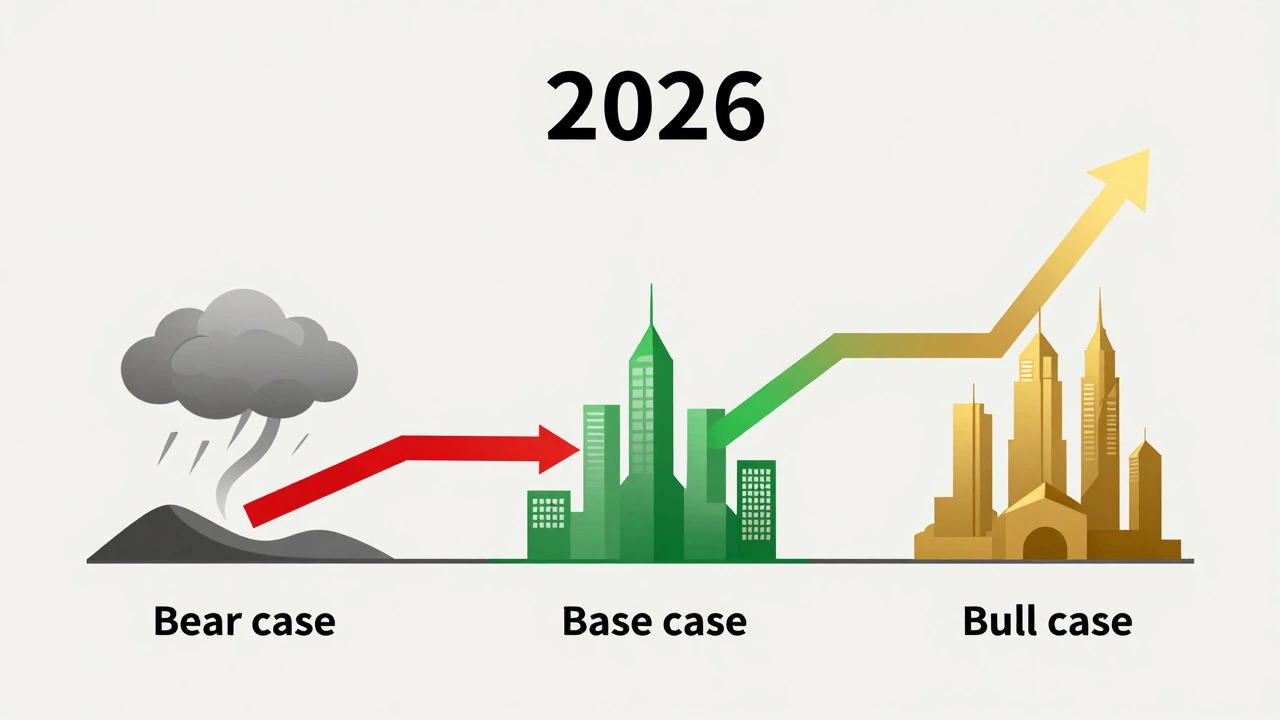
Bear Case
Recession & Regulation
Base Case
Steady Adoption
Bull Case
Global Reserve Asset
Projected Outcome
Value in 2030
Buying Bitcoin with just one hundred dollars feels like a small step, but the question on everyone’s mind is where that money will land four years from now. It is July 2026, and we are sitting in a unique spot in the market cycle. The last halving happened in April 2024, and historically, the biggest price surges happen twelve to eighteen months after that event. We are currently riding that wave, or perhaps nearing its peak. But what happens when the dust settles in 2030?
There is no crystal ball, but there are models, historical patterns, and macroeconomic factors that give us a realistic range. Your $100 could be worth anywhere from $50 if the market crashes hard, to over $1,000 if Bitcoin achieves widespread institutional adoption as a global reserve asset. Let’s break down the scenarios, the math, and the risks so you can make an informed decision rather than gambling on hope.
The Halving Cycle: Why Timing Matters
To understand where Bitcoin goes in 2030, you have to look at its supply mechanism. Bitcoin operates on a predictable schedule called the Halving, which is an event that cuts the reward for mining new blocks in half, reducing the rate of new supply issuance. This happens roughly every four years. The most recent halving occurred in April 2024. Historically, Bitcoin prices tend to bottom out six to twelve months before a halving, surge twelve to eighteen months after it, and then enter a correction phase.
We are currently in the post-halving bull run phase of the 2024-2028 cycle. By 2030, we will likely be deep into the next cycle, following the anticipated halving of 2028. If history repeats itself, 2029 and early 2030 could see another significant rally driven by the scarcity shock from the 2028 halving. However, markets mature over time. The explosive growth seen in 2017 and 2021 may not repeat exactly because the base price is higher and the market cap is larger. Diminishing returns are a real possibility as Bitcoin grows from a speculative asset to a established financial instrument.
Scenario Analysis: Where Could Your $100 Go?
Let’s look at three distinct possibilities for your $100 investment by the end of 2030. These are not guarantees, but they represent plausible outcomes based on current trends and expert consensus.
| Scenario | Assumed BTC Price in 2030 | Value of Initial $100 | Key Drivers |
|---|---|---|---|
| Bear Case | $30,000 | $50 - $150 | Regulatory crackdowns, macro recession, loss of interest |
| Base Case | $150,000 | $600 - $1,200 | Steady adoption, ETF inflows, digital gold narrative holds |
| Bull Case | $500,000+ | $2,000 - $5,000+ | Global reserve currency status, massive corporate treasury adoption |
In the bear case, Bitcoin fails to capture significant new capital. Regulatory hurdles in major economies like the US or EU stifle growth, or a severe global economic crisis forces investors to liquidate all risky assets. In this scenario, your $100 might barely keep pace with inflation or even lose value relative to today’s purchasing power. This is the risk of holding a volatile asset without a clear utility expansion.
The base case assumes continued steady adoption. Bitcoin is widely recognized as "digital gold," a hedge against fiat currency debasement. Institutional investors hold it via Spot ETFs, and central banks continue to print money, keeping demand for scarce assets high. At $150,000 per coin, your initial $100 would grow significantly, offering a strong return that outperforms traditional savings accounts or bonds.
The bull case is the dream scenario. Here, Bitcoin becomes a primary component of national balance sheets or corporate treasuries globally. The network effect strengthens exponentially, and the limited supply of 21 million coins creates intense bidding wars. Analysts like Cathie Wood of ARK Invest have modeled prices reaching $1 million by 2030 under optimal conditions. While extreme, this outcome is not impossible if Bitcoin displaces a portion of gold’s market dominance.
Macro Factors Influencing the 2030 Price
Bitcoin does not exist in a vacuum. Its price is heavily influenced by broader economic conditions. One major factor is Monetary Policy, which refers to actions by central banks to manage money supply and interest rates. If central banks maintain low interest rates or engage in quantitative easing through 2028 and 2029, cash loses value, pushing investors toward hard assets like Bitcoin. Conversely, if inflation is tamed and rates rise sharply, liquidity dries up, hurting crypto prices.
Another critical element is regulatory clarity. By 2030, we expect comprehensive frameworks in place across G20 nations. Clear rules reduce uncertainty for institutional players. For example, the approval of Spot Bitcoin ETFs in 2024 opened the floodgates for traditional finance. If similar products launch for other cryptocurrencies or if tax treatments become more favorable, capital inflows will accelerate. On the flip side, overly restrictive regulations could push innovation offshore, fragmenting the market and potentially dampening price growth.
Technological upgrades also play a role. The Lightning Network continues to improve, enabling faster and cheaper transactions. If Bitcoin solves the scalability trilemma-security, decentralization, and scalability-it could move beyond being just a store of value to becoming a viable medium of exchange. This dual utility would expand its addressable market dramatically, supporting higher valuations.

Risks You Cannot Ignore
Investing in Bitcoin is not without peril. Volatility is inherent to the asset class. Even if the long-term trend is upward, intermediate drops of 30% to 50% are common. If you need that $100 back in two years, timing matters immensely. By 2030, however, you have enough time to ride out multiple cycles.
Security is another concern. Holding Bitcoin requires safeguarding your private keys. If you leave your coins on an exchange, you risk counterparty failure-as seen with FTX in 2022. Using hardware wallets or self-custody solutions mitigates this risk but adds complexity. Also, consider the opportunity cost. That $100 could be invested in index funds, real estate, or education. Bitcoin offers higher potential returns but with significantly higher variance.
Finally, technological disruption is possible. While unlikely given Bitcoin’s entrenched network effect, a superior blockchain could theoretically emerge. Or, quantum computing advancements might threaten cryptographic security, though experts believe post-quantum cryptography updates will be implemented in time.
Strategic Advice for Long-Term Holders
If you decide to buy $100 of Bitcoin today with eyes on 2030, treat it as a long-term savings vehicle, not a get-rich-quick scheme. Dollar-cost averaging (DCA) is a smart strategy. Instead of buying all at once, invest small amounts regularly. This smooths out entry prices and reduces the impact of short-term volatility.
Diversification remains key. Don’t put all your eggs in one basket. Bitcoin should be part of a broader portfolio that includes stocks, bonds, and cash. As a general rule, many financial advisors suggest allocating no more than 1% to 5% of your net worth to high-risk assets like cryptocurrency. For a beginner, $100 is a perfect starting point to learn the mechanics of buying, storing, and tracking crypto without risking financial stability.
Keep an eye on the narrative. Shifts in public perception-from "internet money" to "digital gold" to "global settlement layer"-drive price action. Stay informed about developments in mining sustainability, energy usage, and environmental, social, and governance (ESG) criteria, as these influence institutional acceptance.
Is it too late to buy Bitcoin in 2026?
No, it is not too late. While early adopters saw astronomical returns, Bitcoin’s total addressable market is still growing. With only 19 million coins mined so far, there is significant room for appreciation as adoption spreads globally. The key is managing expectations and focusing on long-term holding rather than short-term speculation.
How much Bitcoin can I buy with $100?
The amount depends on the current price. If Bitcoin is trading at $60,000, $100 buys you approximately 0.0016 BTC. Most exchanges allow fractional purchases, so you don’t need to buy a whole coin. Focus on the dollar value rather than the number of coins.
What is the safest way to store Bitcoin until 2030?
For long-term storage, a hardware wallet is the safest option. Devices like Ledger or Trezor keep your private keys offline, protecting them from online hacks. Avoid leaving large amounts on exchanges unless they are insured and reputable. Back up your recovery phrase securely in multiple physical locations.
Will Bitcoin replace gold by 2030?
Unlikely to fully replace gold, but it may capture a significant share of its market cap. Gold has thousands of years of history as a store of value. Bitcoin is digital, portable, and divisible, offering advantages for younger generations. Many analysts view Bitcoin as "digital gold" rather than a direct replacement, suggesting coexistence rather than displacement.
Does the 2028 halving affect my 2030 investment?
Yes, significantly. The 2028 halving will reduce new supply issuance again, creating scarcity pressure. Historically, the year following a halving sees substantial price increases. If you hold through 2028 and into 2029-2030, you position yourself to benefit from this cyclical supply shock.