
12% Yield Reality Checker
Select the product type offering ~12% return to analyze its viability.
Gross Interest
£0.00
Before tax & inflationRealistic Net Value
£0.00
After estimated costs/risk adj.Key Considerations:
Remember: In finance, higher returns always come with higher risks. There is no free lunch. Use the selector on the left to compare standard savings vs. high-yield investments.
If you are looking at an unknown platform promising 12%+, check these boxes:
You see an ad promising 12% interest on your savings. It sounds too good to be true, because in the world of traditional banking, it usually is. If you walk into a high-street bank today and ask for a fixed-rate bond, they might offer you 4% or 5%. So, where does that double-digit number come from? Is it a scam, a hidden trap, or a genuine opportunity?
The short answer is: yes, you can find returns near 12%, but not by putting your money in a standard savings account. To hit that target, you have to leave the comfort zone of guaranteed capital protection. You are trading safety for yield. This article breaks down exactly where those 12% returns live, what risks you take to get them, and how to decide if it’s worth losing sleep over.
The Reality Check: Why Banks Won’t Give You 12%
Before we hunt for high yields, let’s clear up why your local bank isn’t offering this. Banks make money by lending out your deposits at higher rates than they pay you. If banks were paying 12% on deposits, they’d need to lend that money out at 15% or more to cover costs and profit. Very few borrowers-except maybe credit card holders or payday loan customers-can afford those interest rates. Therefore, standard Savings Accounts are financial products designed for low-risk, liquid storage of cash with modest returns typically cap out around 4-5% in current economic conditions.
If someone offers you 12% on a "savings" product, check the fine print. It’s likely one of three things:
- A promotional teaser rate for just six months.
- An investment product (not a deposit) with no guarantee of principal repayment.
- A fraudulent scheme promising impossible returns.
Option 1: Peer-to-Peer Lending Platforms
This is the most common place people find double-digit returns without buying stocks. Peer-to-Peer (P2P) Lending is a method of debt financing that enables individuals to borrow and lend money without the use of an official financial institution as an intermediary connects lenders directly with borrowers who often can’t get loans from big banks. These borrowers-small businesses or individuals needing quick cash-pay higher interest rates, which passes through to you.
Platforms like Zopa or RateSetter (historical examples, now merged or evolved) used to offer these rates. Today, newer fintech platforms still exist. However, the catch is default risk. If a borrower doesn’t pay back, you lose your money. Most P2P platforms allow you to spread your £10,000 across 200 different loans to dilute this risk. Even then, a bad economic quarter can wipe out a year’s profit.
| Product Type | Typical Return | Capital Protection | Liquidity |
|---|---|---|---|
| Cash ISA | 3.5% - 5.0% | FSCS Protected (£85k) | High (Instant/Notice) |
| P2P Lending | 6% - 12% | None (At Risk) | Low (Lock-ups common) |
| Money Market Funds | 4% - 7% | Not Guaranteed | Medium (T+1 Days) |
| Dividend Stocks | Variable (Yield + Growth) | Market Risk | High (Stock Exchange) |
Option 2: Cash ISAs with Competitive Rates
While 12% is rare for cash, don’t ignore the Individual Savings Account (ISA) a tax-free savings wrapper available to UK residents allowing up to £20,000 per tax year. In September 2026, the best easy-access accounts hover around 4.5% to 5.2%. Fixed-term bonds might push 5.5%.
Is 5% better than 12%? Mathematically, no. But after tax, it might be closer than you think. If you’re a higher-rate taxpayer, a 12% gross return in a non-taxable vehicle might net you less than a 5% return in a Cash ISA if the 12% option is taxable. Always calculate the net return. Furthermore, Cash ISAs are protected by the Financial Services Compensation Scheme (FSCS) up to £85,000 per person, per bank. Your P2P money has zero such shield.

Option 3: Money Market Funds and Short-Term Bonds
If you want something safer than P2P but yielding more than a bank, look at Money Market Funds mutual funds that invest in short-term debt securities and cash equivalents. These aren't technically savings accounts; they are investments. They hold ultra-short-term government bonds and commercial paper.
When interest rates are high, these funds pass that yield to investors. Returns often track the Bank of England base rate closely. If base rates remain elevated in late 2026, you might see 5-6% here. Getting to 12% requires taking slightly longer duration risk-buying bonds that mature in 2-3 years. If interest rates fall before maturity, the bond price rises, giving you a capital gain on top of the coupon. But if rates rise, the price falls. You could end up with less money than you started with if you sell early.
Option 4: Dividend Yield Investing
Here is where 12% becomes realistic but volatile. Some companies, particularly in sectors like tobacco, energy, or real estate investment trusts (REITs), pay high dividends. A stock might have a dividend yield of 7-9%. Add modest share price growth, and you could hit 12% total return.
But beware the "yield trap." Sometimes a yield looks high only because the share price has crashed due to company trouble. For example, a retail chain struggling with online competition might see its yield spike to 12% as investors flee. The next thing you know, they cut the dividend. Always check the payout ratio-the percentage of earnings paid out as dividends. If it’s over 80%, the dividend might not be sustainable.
How to Spot a Scam
Scammers love the number 12%. If you see "Guaranteed 12% Annual Return" on a website you’ve never heard of, run. Here is your checklist:
- Check the FCA Register: Is the firm authorized by the Financial Conduct Authority? If not, you have no recourse if they disappear.
- Ask "How?": How do they generate the return? If the explanation is vague ("algorithmic trading," "crypto arbitrage," "real estate syndication") without a clear audit trail, be skeptical.
- Liquidity Traps: Many high-yield schemes lock your money for 12-24 months. If you try to withdraw early, they charge a penalty or simply say "no."
Making the Decision: Where Should Your Money Go?
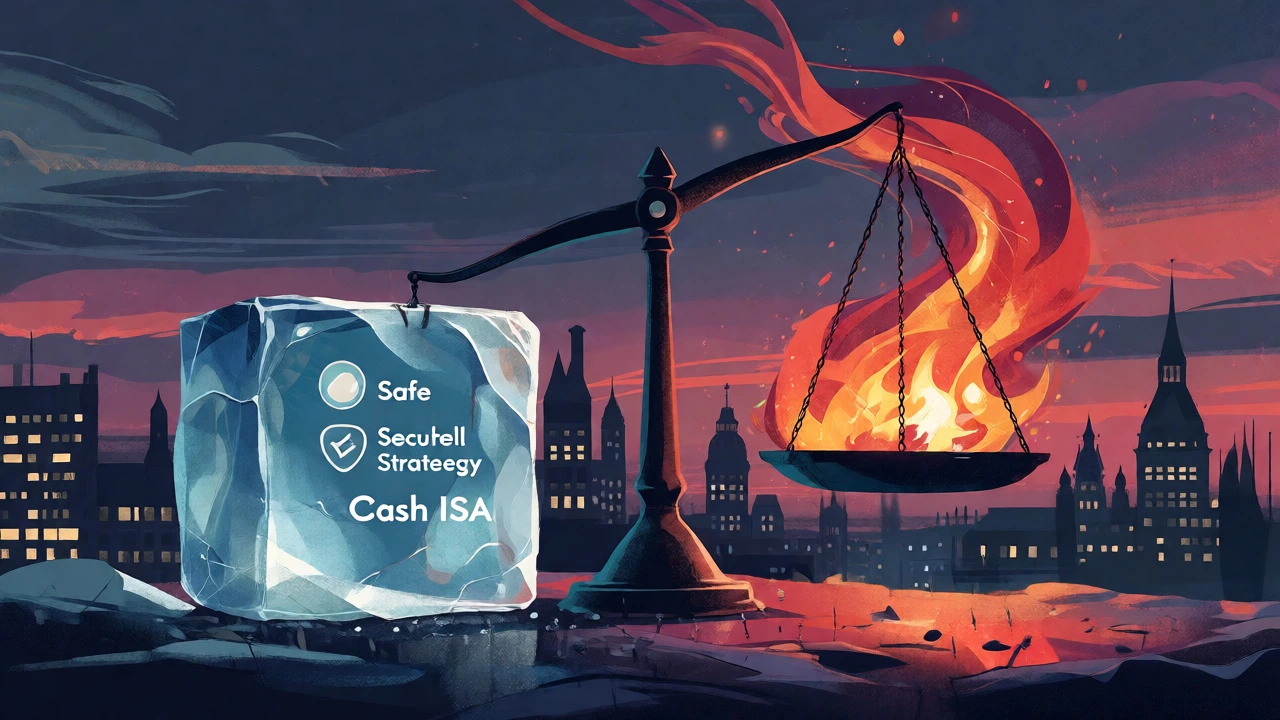
You don’t have to choose one. Use a barbell strategy. Keep 80% of your emergency fund in a safe Cash ISA earning 4.5%. Take the remaining 20% you won’t need for five years and put it into higher-risk vehicles like P2P lending or dividend stocks aiming for 12%.
If you absolutely need 12% and cannot accept any risk of loss, you are looking for something that doesn’t exist. The market prices risk accurately. To beat inflation and grow wealth, you must accept some volatility. Decide how much volatility you can stomach. If watching your balance drop 10% in a month keeps you awake at night, stick to the 5% Cash ISA. Sleep is a valuable asset too.
Is 12% interest on savings guaranteed?
No. Traditional savings accounts are guaranteed up to £85,000 by the FSCS, but they rarely offer 12%. Products offering 12% are typically investments (like P2P lending or stocks) where your original capital is at risk. There is no insurance protecting you against losses in these scenarios.
What is the biggest risk with peer-to-peer lending?
The main risk is borrower default. If people or businesses stop repaying their loans, you lose money. Unlike a bank, P2P platforms don't always cover defaults. Diversification helps, but during economic downturns, many borrowers may default simultaneously, leading to significant losses.
Can I get 12% in a Cash ISA?
It is extremely unlikely. As of 2026, the highest Cash ISA rates are generally between 4% and 5.5%. To get 12% within an ISA wrapper, you would likely need a Stocks and Shares ISA invested in high-growth assets, not a Cash ISA.
Are money market funds safer than savings accounts?
They are very safe but not identical. Savings accounts are insured by the FSCS. Money market funds are not insured, though they invest in high-quality, short-term debt. The risk of losing principal in a money market fund is very low, but theoretically possible, whereas bank savings are fully protected up to the limit.
What happens if I withdraw my money early from a high-interest bond?
You will likely face two penalties. First, you may lose all accrued interest. Second, if interest rates have risen since you bought the bond, the market value of the bond will have fallen, meaning you receive less than you invested if you sell immediately.