
Balance Transfer Calculator
You’ve got a credit card balance hanging over you-maybe it’s grown from unexpected bills, a medical emergency, or just living beyond your means. You see another card with a 0% intro APR offer and wonder: can you pay off a credit card with another credit card? The short answer? Yes, but it’s not as simple as swiping a second card at the checkout. There’s a method, and if you do it wrong, you could end up deeper in debt.
How Paying Off One Credit Card with Another Actually Works
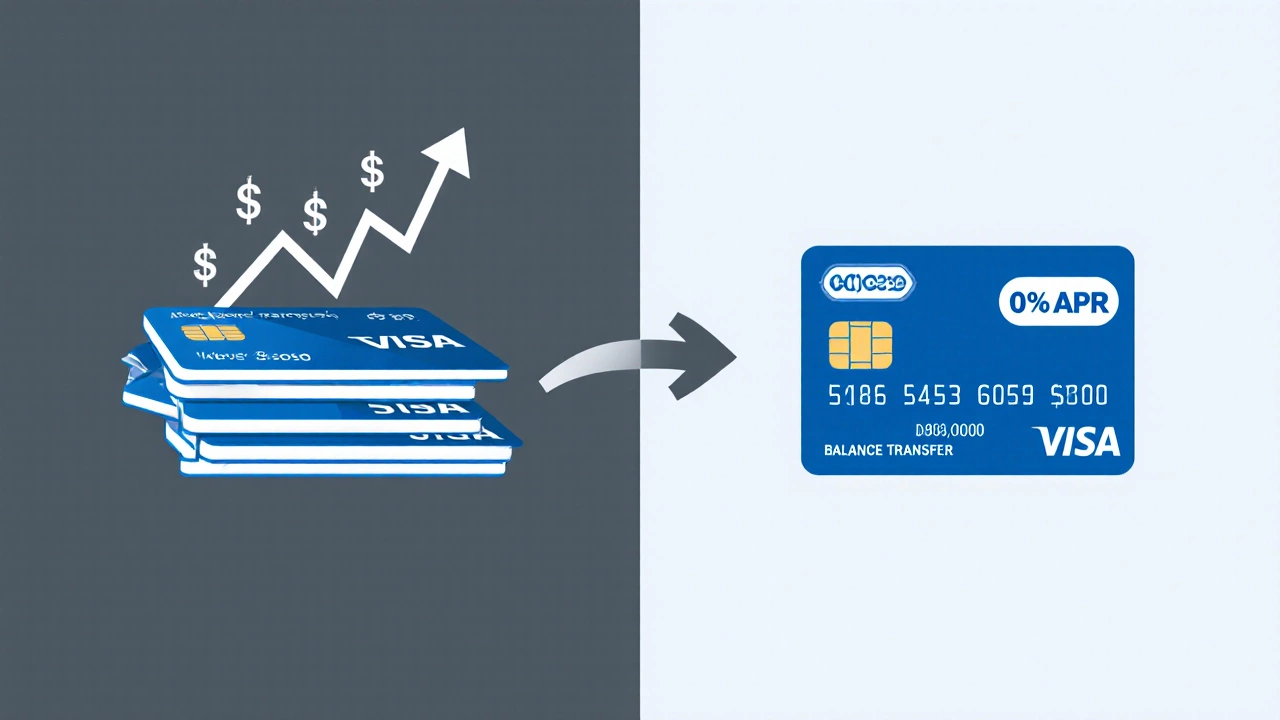
You can’t just hand over your second card to pay your first card’s bill. Credit card companies don’t accept payments from other credit cards directly. What you’re really doing is using a balance transfer. That’s when you move the debt from one card to another, usually one with a lower interest rate.
Here’s how it works in practice: You apply for a new credit card that offers a 0% introductory APR on balance transfers for, say, 18 months. Once approved, you request a balance transfer from your old card to the new one. The new issuer pays off your old card directly. Then you owe the new card company instead. If you pay it off within the promo period, you pay $0 in interest.
This isn’t magic. It’s a financial tool designed to help people escape high-interest debt. In Australia, major banks like Commonwealth Bank, NAB, and ANZ offer balance transfer deals regularly. In 2025, the average intro period for 0% balance transfers is 16-24 months, with fees ranging from 1% to 3% of the amount transferred.
Why This Might Be a Smart Move
Let’s say you’re paying 21% interest on a $5,000 balance. That’s $87.50 a month in interest alone. If you transfer that to a card with 0% for 18 months and pay $280 a month, you’d clear the debt in 18 months with no interest. You’d save over $1,500.
Balance transfers work best when you have a clear repayment plan. People who use them successfully don’t just switch cards-they change habits. They stop using the old card. They set up automatic payments. They track their progress. If you’re serious about getting out of debt, a balance transfer can be the first real step.
The Hidden Costs You Can’t Ignore
Here’s the catch: balance transfers aren’t free. Most cards charge a fee-usually 1% to 3% of the amount you transfer. On a $5,000 transfer, that’s $50 to $150 upfront. That’s not nothing. But it’s still cheaper than paying 20% interest for years.
Another trap: the intro rate doesn’t last. If you don’t pay off the balance before the promo period ends, the rate jumps-often to 20% or higher. That’s worse than your original card. Some people transfer balances repeatedly, thinking they’re outsmarting the system. But each transfer costs money, and lenders track your behavior. Too many transfers in a short time can hurt your credit score and make future approvals harder.
Also, don’t transfer and keep spending. If you transfer $5,000 but keep charging $300 a month on the old card, you’re not solving anything-you’re doubling your debt.
When It’s a Bad Idea
Not everyone should do this. Here are the red flags:
- You have poor credit (under 650). Most 0% offers go to people with good or excellent credit. If your score is low, you might only qualify for cards with high fees or no intro rate.
- You’re already maxed out on credit. Lenders won’t approve you if you’re using 90%+ of your available credit.
- You don’t have a plan to pay it off. If you’re hoping the debt will disappear, it won’t.
- You’re transferring from a card with no fee to one with a fee. That’s just paying more for the same debt.
There’s also a psychological risk. Some people feel like they’ve "solved" the problem after a transfer, so they relax. But the debt is still there. The clock is ticking. You need to treat this like a deadline-not a reset button.
What to Look for in a Balance Transfer Card
Not all balance transfer cards are equal. Here’s what to compare:
| Feature | Card A | Card B | Card C |
|---|---|---|---|
| Intro 0% APR period | 18 months | 24 months | 12 months |
| Balance transfer fee | 2% | 1% | 3% |
| Revert rate after promo | 20.99% | 19.99% | 22.99% |
| Minimum credit score required | 700 | 720 | 680 |
| Annual fee | $0 | $99 | $0 |
Card B looks best for most people: a 24-month intro period, low fee, and decent revert rate. But if you can pay it off in 12 months, Card A is cheaper because of the $0 annual fee. Card C? Only consider it if you have bad credit and no other options.
How to Do It Right
If you’re ready to move forward, here’s your step-by-step:
- Check your credit score. You’ll need at least 650 for decent offers. Use free tools like Credit Simple or Equifax to check.
- Calculate your debt and monthly payment. Can you realistically pay it off before the promo ends? Use a balance transfer calculator.
- Compare 3-5 cards. Look at intro period, fee, revert rate, and annual fee. Don’t get distracted by rewards or travel points.
- Apply for the best one. Only apply for one card at a time. Multiple applications hurt your score.
- Once approved, request the transfer. You’ll need your old card’s account number and the amount to move.
- Stop using the old card. Cut it up or freeze it. Don’t reopen it.
- Set up automatic payments. Even if you pay more than the minimum, automate the payment to avoid missing the deadline.
- Track your progress. Every month, check how much you’ve paid down. Celebrate milestones.
What Happens If You Can’t Pay It Off in Time?
If you still have a balance when the promo ends, you’ll start paying the revert rate. That’s usually high-around 20% or more. But you’re not stuck. You can:
- Transfer the remaining balance to another card with a new promo. But only if you’re confident you can pay it off this time.
- Ask your issuer for a hardship plan. Some banks offer lower rates if you’re struggling.
- Consider a personal loan. Interest rates on personal loans are often lower than credit card revert rates.
Don’t ignore it. The longer you wait, the more interest piles up. And missed payments will tank your credit score.

Alternatives to Balance Transfers
Balance transfers aren’t the only way out. Here are other options:
- Personal loan: Fixed rate, fixed term. Often cheaper than credit card revert rates. You get a lump sum to pay off your cards.
- Debt consolidation: Combines multiple debts into one payment. Works well if you have more than one card.
- Debt management plan: Through a nonprofit credit counselor. They negotiate lower rates with your creditors.
- Zero-interest payment plan: Some retailers and medical providers offer 0% financing for a set time.
Personal loans are often the best alternative. They’re simpler, have lower rates, and no fees. If you have good credit, you might get a 9%-12% personal loan-far better than a 22% credit card.
Final Thoughts: Is It Worth It?
Can you pay off a credit card with another credit card? Yes. Should you? Only if you’re ready to commit to paying it off within the promo period. It’s not a quick fix. It’s a tool. And like any tool, it can help you build something better-or make things worse if you misuse it.
The goal isn’t to swap cards. It’s to erase debt. If you can do that in 18 months, you’ll save thousands. If you can’t, you’ll pay more in fees and interest than you saved. Be honest with yourself. If you’ve been chasing debt with more debt, it’s time to break the cycle.
Can I transfer a balance from one card to another if they’re from the same bank?
No. Most banks don’t allow balance transfers between cards issued by the same institution. For example, you can’t transfer from your CBA Visa to your CBA Mastercard. You need to use a card from a different bank. This rule exists to prevent people from moving debt around without actually paying it down.
Will a balance transfer hurt my credit score?
It can, temporarily. Applying for a new card triggers a hard inquiry, which drops your score by 5-10 points. Also, if you transfer a large balance, your credit utilization on the new card might spike. But if you pay it off quickly, your score will recover-and likely improve as you reduce overall debt. The long-term benefit of paying down debt usually outweighs the short-term dip.
How many balance transfers can I do in a year?
There’s no official limit, but doing more than two or three in a year raises red flags. Lenders see frequent transfers as a sign of financial stress. It can make future applications harder. Plus, each transfer costs money. If you’re constantly moving debt, you’re not solving it. Focus on paying it off, not shifting it.
Can I transfer cash advances or fees from my old card?
Usually not. Most balance transfer offers only cover purchase balances, not cash advances, fees, or interest charges. Cash advances have their own rules and higher rates. If you have a cash advance balance, you’ll need to pay it off separately-often with a personal loan or savings.
What if I get approved but don’t use the balance transfer?
You won’t be charged a fee unless you actually transfer the balance. But you might still be stuck with an annual fee if the card has one. Also, you’ve already taken a hit to your credit score from the application. If you don’t use the offer, you’ve lost the benefit and gained nothing. Only apply if you’re ready to move the debt.
Next Steps
Start by checking your current credit card balance and the interest rate. Then check your credit score. If it’s above 650, look at the top 3 balance transfer cards available right now. Pick one with the longest 0% period and lowest fee. Don’t wait for the "perfect" offer-timing matters. The longer you wait, the more interest you pay.
If you’re unsure, talk to a free financial counselor through the National Debt Helpline. They can help you compare options and build a realistic plan. You don’t need to fix everything today. But you do need to start.