
Crypto Investment Calculator
Your Investment
Investment Results
Current price is based on real-time data. Prices change frequently.
Enter your investment details above to see your results.
Recommended Allocation
Dollar-Cost Averaging
Investing regularly can reduce market volatility risk.
Example: $50 weekly for 12 months = $600 total investment
Starting out in cryptocurrency investing doesn’t have to feel like jumping into deep water without knowing how to swim. In fact, millions of regular people - teachers, nurses, tradespeople - have built small crypto portfolios without ever touching a trading terminal. If you’re new to this, you’re not behind. You’re just getting started. And this guide will show you exactly how to begin, step by step, with no jargon, no hype, and no guesswork.
Understand What You’re Actually Buying
Cryptocurrency isn’t a stock, a bond, or a mutual fund. It’s digital money built on a public ledger called a blockchain. The most well-known is Bitcoin is a decentralized digital currency created in 2009 that operates without a central bank or single administrator. Also known as BTC, it was the first cryptocurrency and still holds the largest market share.. But there are thousands of others - Ethereum is a blockchain platform that enables smart contracts and decentralized applications. Also known as ETH, it powers a wide range of financial and non-financial applications on its network., Solana is a high-speed blockchain designed for scalable decentralized applications and fast transaction processing. Also known as SOL, it became popular for its low fees and high throughput., Cardano is a proof-of-stake blockchain platform focused on sustainability, scalability, and security through peer-reviewed research. Also known as ADA, it was launched in 2017 with a scientific approach to development., and more. Each one serves a different purpose. Bitcoin is mostly seen as digital gold - a store of value. Ethereum is the backbone of decentralized finance (DeFi) and NFTs. Others fix speed or cost problems in the network.
Don’t chase trends. Don’t buy because someone on TikTok said so. Start by learning what each coin actually does. Read its whitepaper if you can - most are written in plain language. Look at how long it’s been around, who’s behind it, and whether it’s used by real people or just speculators.
Start Small - Like Really Small
Many beginners think they need to buy a whole Bitcoin to get started. That’s not true. You can buy as little as $5 worth of Bitcoin or Ethereum. Most exchanges let you invest in fractions. For example, if Bitcoin is $70,000, $5 gets you about 0.00007 BTC. That’s enough to learn how it works without risking your rent money.
Set a budget. Decide how much you’re comfortable losing - not how much you hope to gain. Crypto is volatile. Prices can swing 20% in a day. If you can’t sleep if your investment drops by half, you’re putting in too much. A good rule of thumb: never invest more than 1-5% of your total savings. For most people, that’s $100 to $500 to start. Treat it like a learning experiment, not a get-rich-quick scheme.
Choose a Reputable Exchange
You can’t buy crypto with your bank account directly. You need a crypto exchange is a digital platform where users can buy, sell, and trade cryptocurrencies. Also known as cryptocurrency trading platform, it connects buyers and sellers using order books or automated pricing.. There are hundreds, but stick to the big, regulated ones if you’re new.
In Australia, these are trusted options:
- CoinSpot - Easy for beginners, supports over 500 coins, good customer service
- Independent Reserve - Fully licensed in Australia, holds funds in cold storage
- Swyftx - Simple interface, low fees, popular with young investors
- Binance - Global giant, lowest fees, but more complex for new users
Sign up with your ID and bank details. Most exchanges require identity verification (KYC) - it’s normal. Once approved, link your bank account or use a debit card to deposit AUD. Avoid using credit cards. Crypto isn’t a gamble - don’t borrow to invest.
Set Up a Secure Wallet
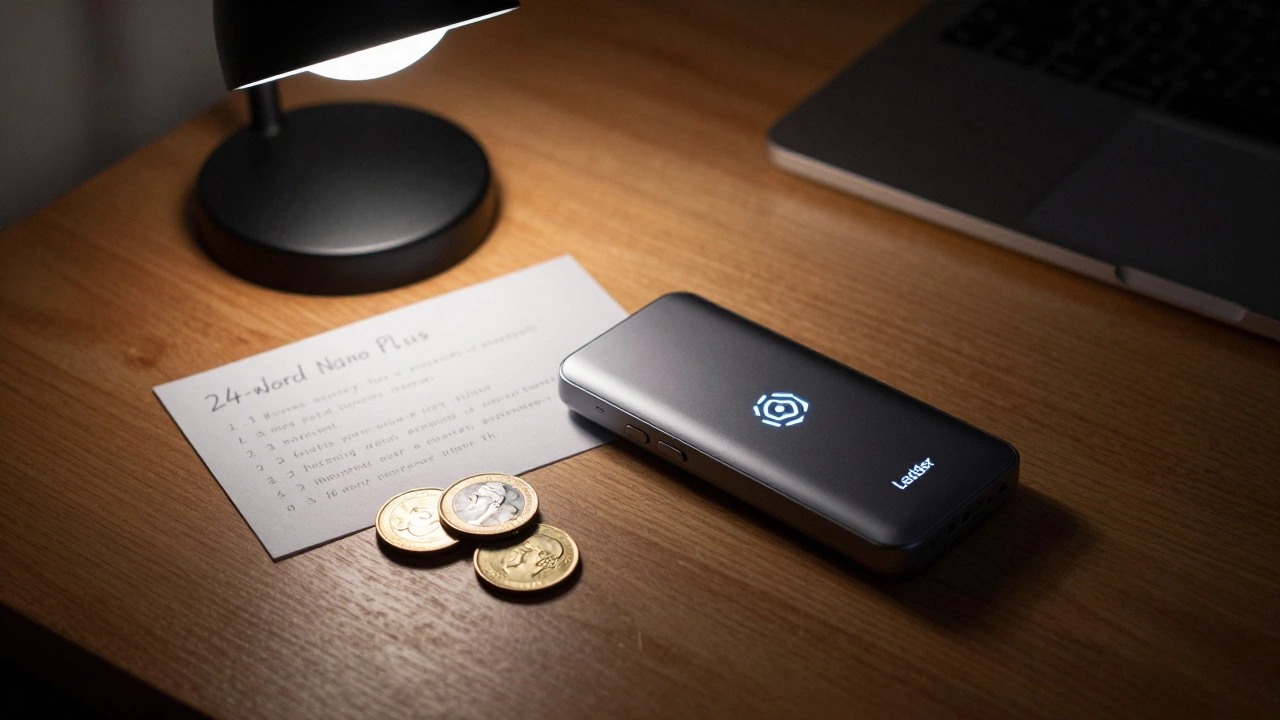
When you buy crypto on an exchange, it’s stored there - like money in a bank. But exchanges can get hacked. That’s why you need a crypto wallet is a digital tool that stores private keys to access and manage cryptocurrency holdings. Also known as digital wallet, it can be software-based (hot wallet) or hardware-based (cold wallet)..
There are two types:
- Hot wallets - Apps on your phone or computer. Easy to use, good for small amounts you want to trade. Examples: Trust Wallet, MetaMask.
- Cold wallets - Physical devices like Ledger or Trezor. Like a USB drive for crypto. No internet connection = much harder to hack. Best for holding more than $500 long-term.
Here’s what to do:
- Buy a Ledger Nano S Plus or Trezor Model T (around $80-$120) - it’s worth it
- Set up the device using the official app
- Write down your 24-word recovery phrase - on paper, not digital
- Send a small amount of crypto from the exchange to your wallet to test it
Never lose that recovery phrase. If you do, you lose your crypto forever. No one can recover it for you.
Diversify - But Don’t Overcomplicate
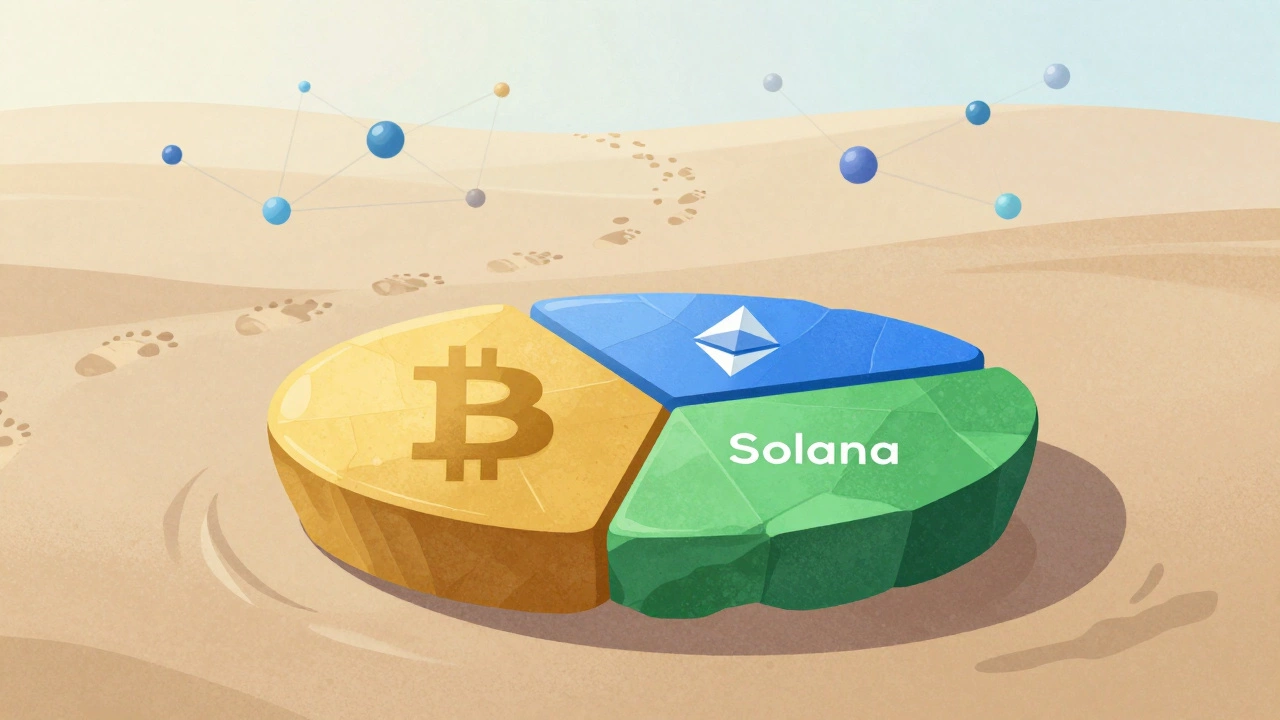
Don’t put all your money into one coin. Even Bitcoin can crash. Ethereum can stall. New coins can disappear. A beginner portfolio should be simple:
- 60% Bitcoin - the most proven
- 30% Ethereum - the most used ecosystem
- 10% one other coin you understand (like Solana or Cardano)
Buy in slowly. Don’t try to time the market. Instead, use dollar-cost averaging. That means buying the same amount every week or month - $20, $50, whatever fits your budget. Even if prices drop, you’re buying more at lower prices. This smooths out the rollercoaster.
Ignore the Noise
Reddit, Twitter, YouTube - they’re full of people shouting about 10x gains. Ignore them. Real investors don’t post about their profits. They quietly hold. They don’t tweet about “moon missions.” They check their portfolio once a month.
Here’s what to do instead:
- Follow official project blogs - not influencers
- Read quarterly updates from teams you trust
- Use CoinGecko or CoinMarketCap to track prices - not memes
- Set price alerts so you’re not constantly checking
If you feel FOMO (fear of missing out), walk away. Take a walk. Drink water. Come back tomorrow. Crypto moves fast, but your decisions shouldn’t.
Keep Records and Know the Tax Rules
In Australia, the Australian Taxation Office is the government agency responsible for administering tax laws and superannuation. Also known as ATO, it treats cryptocurrency as property for tax purposes. treats crypto like property. Every time you sell, trade, or spend it, you may owe capital gains tax.
Keep a record of:
- When you bought crypto (date and price in AUD)
- When you sold or traded it (date and price)
- Any fees paid
You don’t pay tax when you buy - only when you dispose of it. If you hold for over a year, you get a 50% discount on capital gains. Use tools like Koinly or CoinTracker to auto-sync your transactions. They’ll generate reports for your accountant. Don’t wait until tax time to figure this out.
What to Avoid
Here are the biggest mistakes beginners make:
- Buying crypto you don’t understand - If you can’t explain what Solana does in one sentence, don’t buy it.
- Using unregulated platforms - If a site isn’t listed on ASIC’s register, don’t trust it.
- Investing money you need - Emergency fund first. Crypto second.
- Chasing pumps - If a coin spikes 50% in a day, it’s likely a scam or a pump-and-dump.
- Sharing your private keys - Ever. Not even with "tech support." No legitimate service asks for this.
Final Thought: This Is a Marathon
Cryptocurrency investing isn’t about getting rich overnight. It’s about learning how money works in a digital world. The people who succeed aren’t the ones who bought at the bottom. They’re the ones who stayed in, kept learning, and didn’t panic.
Start small. Stay consistent. Keep learning. In a year, you’ll look back and be glad you didn’t wait.
Can I invest in cryptocurrency with $10?
Yes. Most exchanges let you buy fractions of a coin. With $10, you can get a tiny piece of Bitcoin, Ethereum, or other major cryptocurrencies. It’s a great way to learn how the system works without risking much. Just make sure you use a trusted exchange and transfer your coins to a personal wallet once you’re comfortable.
Is cryptocurrency safe to invest in?
The technology behind crypto - blockchains - is very secure. But the risk comes from human behavior: scams, bad exchanges, lost passwords, and emotional trading. If you use regulated platforms, store your crypto in a hardware wallet, and only invest what you can afford to lose, it’s as safe as any other investment. But don’t treat it like a bank account. It’s not insured like your savings.
Do I need to pay tax on crypto in Australia?
Yes. The ATO considers cryptocurrency an asset. You pay capital gains tax when you sell, trade, or spend it. For example, if you buy Bitcoin for $1,000 and sell it later for $1,500, you owe tax on the $500 profit. Holding for over a year gives you a 50% discount. Keep records of every transaction - dates, amounts, fees - and use crypto tax software to simplify reporting.
What’s the best crypto for beginners?
Start with Bitcoin and Ethereum. They’re the most established, have the largest networks, and are accepted by most exchanges and wallets. Bitcoin is digital gold - a store of value. Ethereum powers apps and smart contracts. Together, they cover most of the crypto market. Once you understand them, you can explore others like Solana or Cardano.
How do I know if a crypto exchange is safe?
Look for these signs: 1) It’s licensed by ASIC (Australia’s financial regulator), 2) It stores most funds in cold storage (offline), 3) It has two-factor authentication (2FA), 4) It has been around for at least 3-5 years, and 5) It has clear customer support. Avoid exchanges that promise high returns, don’t require ID, or have poor reviews. Independent Reserve and CoinSpot are good starting points in Australia.