
Budget Rule Calculator
Your Monthly Breakdown
Enter your income to see the calculated distribution.
The Popular Heavyweight: The 50/30/20 Rule
If you're looking for a starting point, the 50/30/20 rule is a straightforward budgeting method that divides your after-tax income into three specific categories: needs, wants, and savings. It's designed to give you a high-level view of your spending without making you categorize every single coffee purchase.
Here is how the split actually works in the real world:
- 50% for Needs: These are non-negotiables. Think rent or mortgage payments, basic groceries, utilities, and minimum debt payments. If you can't live without it or you'll end up homeless or unemployed, it's a need.
- 30% for Wants: This is your "lifestyle" fund. Dining out, Netflix subscriptions, that new pair of sneakers, or a weekend trip. This is the category most people overspend in.
- 20% for Savings and Debt Repayment: This goes toward your Emergency Fund, retirement contributions, or paying off the principal on a high-interest loan.
For example, if you bring home $4,000 a month after taxes, you'd aim for $2,000 for bills, $1,200 for fun, and $800 for your future. The magic here is that it prioritizes savings without stripping away the joy of spending. But does it work for everyone? Not necessarily. If you live in a city like Sydney or New York where rent eats up 40% of your income alone, the "50% needs" part can feel like a fantasy.
The Minimalist Approach: The 70/20/10 Rule
For those who struggle to save or are aggressively tackling debt, the 70/20/10 rule shifts the priority. This is essentially a more conservative version of the previous rule, often used by people who want to accelerate their wealth building or get out of a financial hole faster.
The breakdown looks like this:
- 70% for Living Expenses: This combines your needs and wants into one big bucket. It simplifies things-you just have a set amount to live on.
- 20% for Savings: A larger chunk goes straight into investments or a high-yield savings account.
- 10% for Debt Repayment or Giving: This allows you to carve out a specific piece of the pie for paying off credit cards or donating to charity.
| Rule | Focus | Best For... | Complexity |
|---|---|---|---|
| 50/30/20 | Balanced Lifestyle | Beginners & Average Earners | Low |
| 70/20/10 | Wealth Building | Aggressive Savers | Very Low |
| Zero-Based | Precision Control | Debt Recovery / High Detail | High |
For the Control Freaks: Zero-Based Budgeting
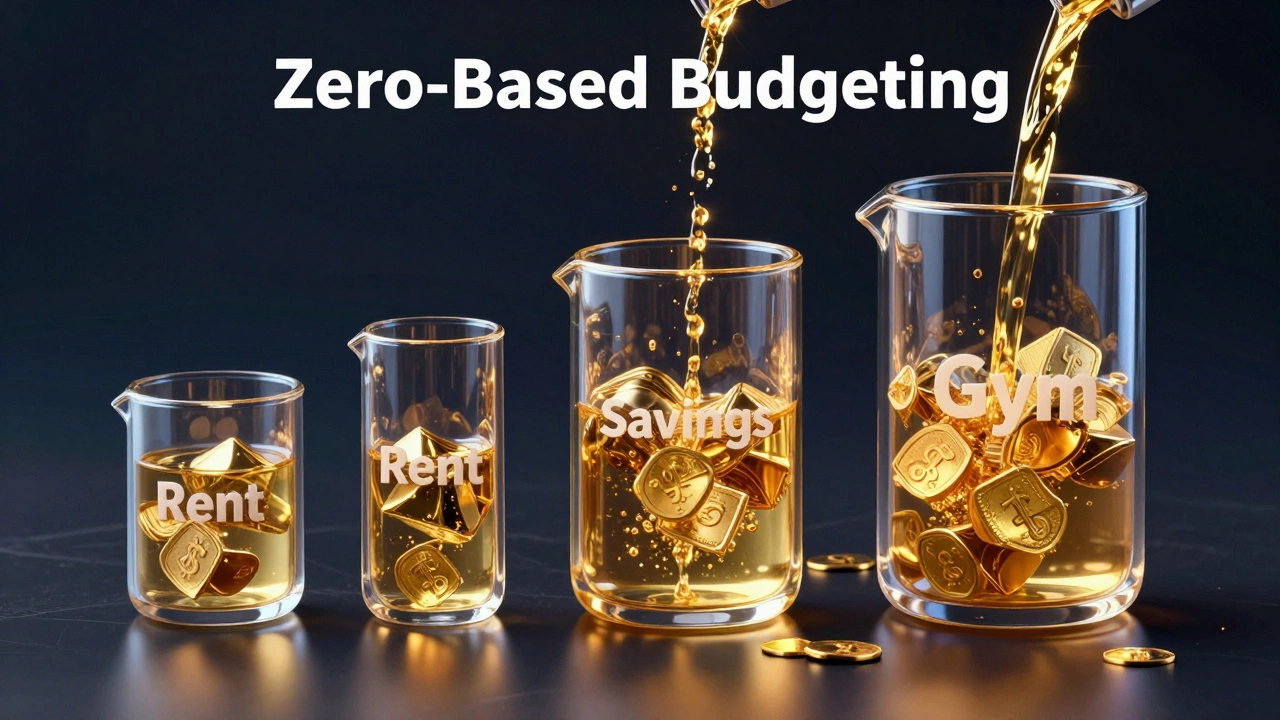
If you find that money still "leaks" out of your account despite following percentages, you might need Zero-Based Budgeting. This isn't about having zero dollars in your bank account; it's about giving every single dollar a job until your income minus your expenses equals exactly zero.
Imagine your income is a team of employees. You don't just let them hang around the office; you assign them specific tasks. $1,200 goes to rent, $300 to electricity, $200 to the gym, and $500 to a Roth IRA. If you have $10 left over at the end of your planning, you don't leave it as "extra"-you assign it to a "miscellaneous" category or put it toward a specific goal.
This method is incredibly powerful for people with irregular incomes or those using the Debt Snowball Method to pay off multiple loans. By knowing exactly where every cent goes, you eliminate the "invisible spending" that happens when you have a vague sense of how much you can spend.
The "Pay Yourself First" Philosophy
Some people hate budgeting altogether. If the idea of a spreadsheet makes you break out in hives, try the "Pay Yourself First" approach. This is less of a rule and more of a psychological flip.
Instead of spending money and saving what's left, you save first and spend what's left. The moment your paycheck hits, you automatically transfer a set amount-say 15%-into a separate savings or investment account. Once that is gone, you can spend the rest of your money however you want. As long as the savings goal is met, you don't need to track whether you spent too much on takeout or clothes.
This works because it utilizes Automation. By removing the decision-making process from the equation, you bypass the temptation to spend that money. It turns saving from a chore into a background process.
Common Budgeting Pitfalls to Avoid
Even with the best rule, most people fail because they forget a few critical details. First, they forget irregular expenses. Your car registration doesn't happen every month, but it's a guaranteed expense. If you only budget for monthly bills, these "surprise" annual costs will blow your 50/30/20 split apart.
Second, they are too rigid. If you have a bad month and spend 40% on wants instead of 30%, don't scrap the whole system. Just adjust the next month. A budget is a compass, not a cage. If you treat it like a law, you'll eventually rebel against it and go on a spending spree.
Finally, avoid the trap of "lifestyle creep." As you earn more, it's tempting to increase your "wants" category. The ideal budget rule is the one that allows you to increase your savings rate as your income grows, rather than just buying a nicer car.

Choosing the Right Rule for Your Life
How do you actually pick? It depends on your current financial stage. If you are just starting and feel overwhelmed, go with 50/30/20. It's the most forgiving and provides a clear picture of your health. If you are in a high-cost-of-living area and struggling to save, try the 70/20/10 split to force more money into your future.
If you are fighting a battle with credit card debt or have a variable income (like freelance work), Zero-Based Budgeting is your best bet. It provides the granular control needed to ensure you don't slide backward. And if you've already built a decent cushion and just want to maintain it, "Pay Yourself First" is the lowest-stress option available.
Is the 50/30/20 rule realistic for people with low incomes?
In many cases, no. For those with lower incomes, "needs" like housing and food often take up 70% or 80% of their pay. In this scenario, the rule should be used as a target rather than a strict requirement. Focus first on reducing fixed costs or increasing income before stressing over the exact percentages.
What happens if I spend more than 30% on wants?
If you overspend in your "wants" category, you have two choices: take that money from your "needs" (which usually isn't possible) or take it from your "savings." If you consistently dip into your 20% savings to fund your lifestyle, you're essentially stealing from your future self. The goal is to adjust your spending habits until the 30% feels sustainable.
Does Zero-Based Budgeting take too much time?
It takes more time upfront than percentage-based rules, but it actually saves time in the long run by eliminating financial anxiety. Once you have your categories set up in an app or spreadsheet, you're mostly just tracking spending rather than redesigning the plan every month.
Should I include debt payments in the "needs" category?
Minimum payments on debts are considered needs because failing to pay them has severe consequences. However, any extra payments made to pay down the principal faster should be categorized under "savings/debt repayment." This keeps your baseline survival cost clear while showing how much you're actively improving your net worth.
How often should I review my budget?
A monthly check-in is the gold standard. Review your spending at the end of the month to see where you went over and adjust the categories for the following month. If you're using Zero-Based Budgeting, a weekly check-in helps keep you on track before you accidentally spend your entire "dining out" budget by the 10th.
Next Steps to Get Started
Don't try to implement a complex system overnight. Start by tracking your spending for just 30 days without changing anything. Use a simple app or a notebook. Once you have the data, see which rule fits your current reality. If your needs are already at 60%, don't force a 50/30/20 rule; start with a 60/20/20 split and work your way down.
If you're feeling stuck, pick one "want" to eliminate this month-like a subscription you don't use-and move that exact amount into a separate savings account. That small win proves that the system works and builds the momentum you need to stick with a long-term rule.