40/40/20 Budget Calculator
See how the aggressive 40/40/20 model shifts your priorities compared to the standard advice.
Most of us have tried the 50/30/20 rule. You know the one: half for needs, a third for wants, and a tenth for savings. It sounds logical on paper, but in practice, it often feels like a recipe for frustration. If you live in a city with high rent, pay off student loans, or simply want to hit your retirement goals faster, that old formula might be leaving you behind.
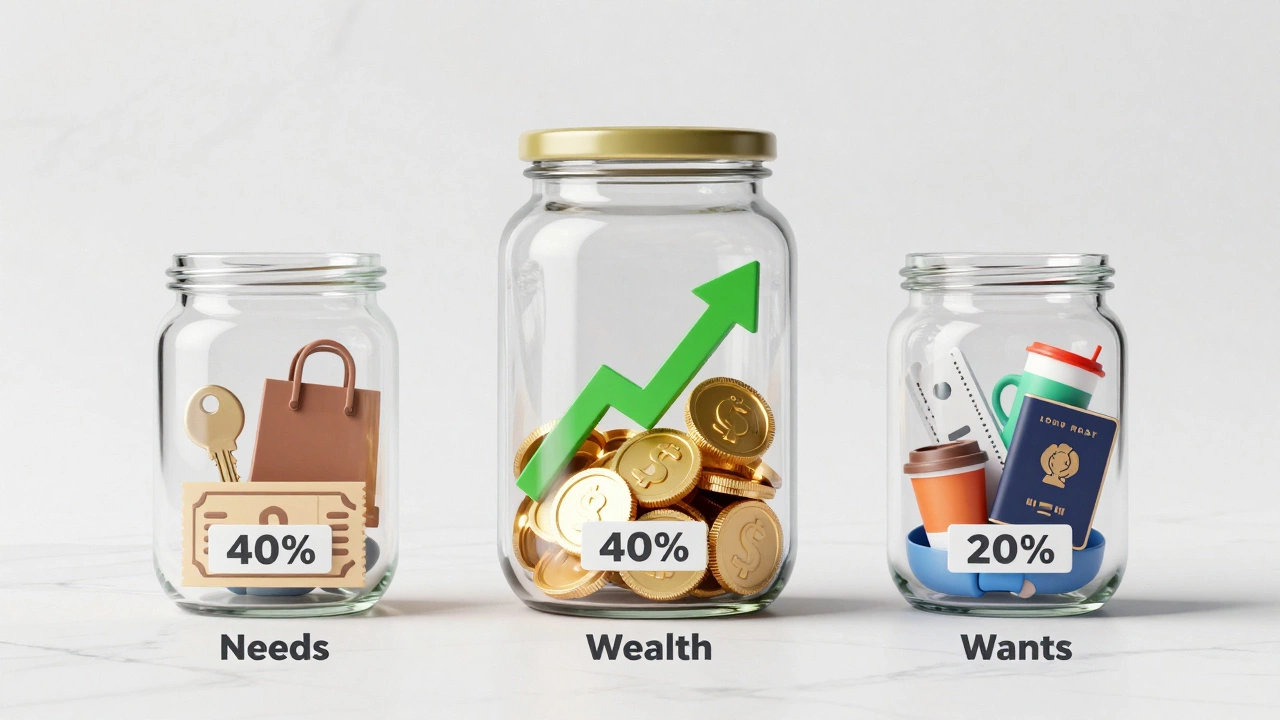
Enter the 40/40/20 budget, which is a personal finance framework that allocates 40% of income to essentials, 40% to long-term wealth building, and 20% to discretionary spending. This method flips the script on traditional advice. Instead of treating savings as an afterthought, it makes wealth creation the primary focus of your monthly cash flow.
The Core Philosophy Behind the Numbers
The beauty of this system lies in its simplicity. You take your net income-what hits your bank account after taxes-and split it into three distinct buckets. The numbers are rigid, but the mindset is flexible.
Here is how the breakdown works:
- 40% for Needs: These are the non-negotiables. Rent or mortgage payments, utilities, groceries, insurance premiums, and minimum debt repayments. If you don’t pay these, life falls apart.
- 40% for Wealth Building: This is where the magic happens. This portion goes toward extra debt repayment, emergency funds, retirement accounts, and investments. It’s not just "saving"; it’s actively growing your net worth.
- 20% for Wants: This is your guilt-free fun money. Dining out, hobbies, subscriptions, travel, and impulse buys. The key here is that once this bucket is empty, you stop spending on luxuries until next month.
Unlike the 50/30/20 rule, which prioritizes current lifestyle comfort, the 40/40/20 model prioritizes future security. It forces you to ask a tough question: Are you willing to tighten your belt now to buy your freedom later?
How It Compares to Other Budgeting Methods
To understand why the 40/40/20 rule resonates with so many people today, we need to look at how it stacks up against other popular methods. Most budgeting systems fall into two camps: those that track every penny (like zero-based budgeting) and those that use broad percentages (like envelope systems).
| Method | Needs Allocation | Savings/Wealth | Wants/Lifestyle | Best For |
|---|---|---|---|---|
| 50/30/20 Rule | 50% | 20% | 30% | People with moderate expenses who want a balanced approach. |
| 40/40/20 Rule | 40% | 40% | 20% | Aggressive savers, debt payers, and those seeking early retirement. |
| Zero-Based Budget | Variable | Variable | Variable | Detail-oriented individuals who want total control over every dollar. |
| Paying Yourself First | Variable | Fixed Amount | Remaining Balance | Those who struggle with discipline and need automatic savings. |
The shift from 20% to 40% for savings is significant. In the traditional model, if you earn $5,000 a month, you save $1,000. With the 40/40/20 rule, you save $2,000. That extra $1,000 doesn't just sit there; thanks to compound interest, it can grow exponentially over time. However, this aggressive saving rate requires a corresponding reduction in either your needs or your wants.

Step-by-Step Implementation Guide
Adopting a new budgeting style isn't about willpower; it's about structure. Here is how you can set up the 40/40/20 budget without feeling deprived.
- Calculate Your Net Income: Look at your paycheck after tax, superannuation contributions, and other deductions. Use this number, not your gross salary, for all calculations.
- Audit Your Current Spending: Pull your bank statements from the last three months. Categorize every transaction into Needs, Wants, or Savings. Be honest. That daily coffee counts as a Want.
- Set Up Three Accounts: Open separate bank accounts for each category. Name them clearly: "Essentials," "Future Me," and "Fun." Visual separation helps mental separation.
- Automate the Transfers: On payday, immediately transfer 40% to Essentials, 40% to Future Me, and 20% to Fun. Automation removes the temptation to spend what you haven't yet allocated.
- Adjust Your Lifestyle: If your current needs exceed 40%, you have two choices: increase your income or reduce your fixed costs. This might mean downsizing your apartment, refinancing your car loan, or cooking more meals at home.
The hardest part is usually the initial adjustment period. You might feel tight for the first few months. But remember, this is temporary. As you build habits, the 20% for wants becomes enough because you stop wasting money on things you don't truly value.
Real-Life Scenarios: Does It Work for Everyone?
No budgeting rule is universal. Let’s look at two different personas to see how the 40/40/20 rule plays out in reality.
Scenario A: Sarah, the Young Professional
Sarah earns $6,000 a month. She lives alone in Sydney. Her rent is $2,400 (40%). Her groceries and bills come to $600. Total needs: $3,000. This fits perfectly into the 40% bracket. She transfers another $2,400 to her investment portfolio and emergency fund. She keeps $1,200 for dining out, gym memberships, and travel. Sarah thrives under this system because her housing cost is manageable relative to her income.
Scenario B: Mark, the Family Man
Mark earns $8,000 a month. He has a mortgage of $3,500, school fees of $1,000, and household expenses of $1,500. His total needs are $6,000, which is 75% of his income. The 40/40/20 rule breaks down here. Mark cannot cut his needs by half overnight. For Mark, this rule serves better as a long-term goal rather than an immediate tactic. He might start by aiming for a 60/20/20 split and gradually move toward 40/40/20 as his mortgage decreases.
This highlights a critical point: the 40/40/20 rule works best when your fixed costs are low. If your rent or mortgage eats up more than 40% of your income, you need to focus on increasing your income stream before applying this ratio strictly.

Troubleshooting Common Pitfalls
Even the best plans fail if you don't account for human nature. Here are the most common hurdles people face when switching to this model.
The "Needs" Creep
It’s easy to classify things as "needs" when they’re actually "wants." Is a premium internet plan a need? Probably not. Is a brand-new smartphone every year a need? No. Regularly audit your essential expenses. Challenge every subscription and recurring charge. If you can survive without it for a month, it’s likely a want.
The Emergency Fund Trap
Many people put their entire 40% savings allocation into a low-interest savings account. While having cash on hand is vital, inflation erodes its value over time. Once you have 3-6 months of expenses saved, direct the bulk of that 40% toward higher-yield vehicles like index funds, ETFs, or high-interest term deposits. Make your money work harder.
Burnout from Restriction
Living on 20% for fun can feel restrictive. To avoid burnout, make your 20% count. Don’t waste it on small, unnoticed purchases. Use it for experiences that bring genuine joy. A weekend trip, a nice dinner, or a hobby course is far more satisfying than dozens of small online purchases that vanish from memory instantly.
Advanced Tips for Maximizing the System
Once you’ve mastered the basics, you can tweak the 40/40/20 rule to accelerate your financial goals.
- Income Spikes: When you get a bonus, tax refund, or side hustle income, allocate 100% of it to the "Wealth Building" bucket. This accelerates your progress without impacting your daily lifestyle.
- Debt Snowball Integration: If you have high-interest debt, treat the 40% wealth bucket as a debt-slaying machine. Pay minimums on all debts, then throw the entire 40% at the highest-interest loan. Once that’s gone, redirect that cash flow to investing.
- Review Quarterly: Life changes. Your income might rise, or your rent might go up. Review your allocations every three months. Adjust the percentages slightly if needed, but keep the core philosophy intact: prioritize wealth building.
The 40/40/20 budget is not just a math problem; it’s a psychological shift. It trains you to value future security over present comfort. It’s challenging, yes, but the payoff is a life where you work for money, not the other way around.
Is the 40/40/20 rule better than the 50/30/20 rule?
It depends on your financial goals. The 40/40/20 rule is superior for aggressive wealth building and debt elimination because it doubles the savings rate. However, the 50/30/20 rule is more realistic for people with high living costs or those who prioritize current lifestyle enjoyment. Choose based on whether you want to retire early or live comfortably now.
Can I use the 40/40/20 budget if I have student loans?
Yes, absolutely. In fact, it’s ideal for this scenario. Treat your student loan payments as part of the 40% "Wealth Building" category. By allocating a large chunk of your income to debt repayment, you clear the obstacle faster, freeing up cash flow for investing once the loans are gone.
What do I do if my essential expenses exceed 40% of my income?
If your needs are over 40%, you cannot strictly follow this rule yet. Focus on reducing fixed costs (like moving to a cheaper place) or increasing your income (through side hustles or career advancement). Use the 40/40/20 ratio as a target goal rather than an immediate mandate until your finances align.
Does the 20% for wants include entertainment and hobbies?
Yes. The 20% bucket covers all discretionary spending. This includes dining out, streaming services, gym memberships, travel, and hobbies. The key is to stay within this limit. If you spend more on fun, you must take it from the savings bucket, which defeats the purpose of the system.
How does inflation affect the 40/40/20 budget?
Inflation increases the cost of "Needs," potentially pushing them above the 40% threshold. To combat this, ensure your income grows faster than inflation. Additionally, invest the 40% savings portion in assets that historically outpace inflation, such as stocks or real estate, rather than keeping it all in cash.