Savings Interest Earnings Calculator
Projected Earnings
Quick Takeaways for Your $1,000
- Standard Savings: Expect very low returns, often under 0.50% APY.
- High-Yield Savings: Can earn significantly more, often between 4.00% and 5.00% APY in the current market.
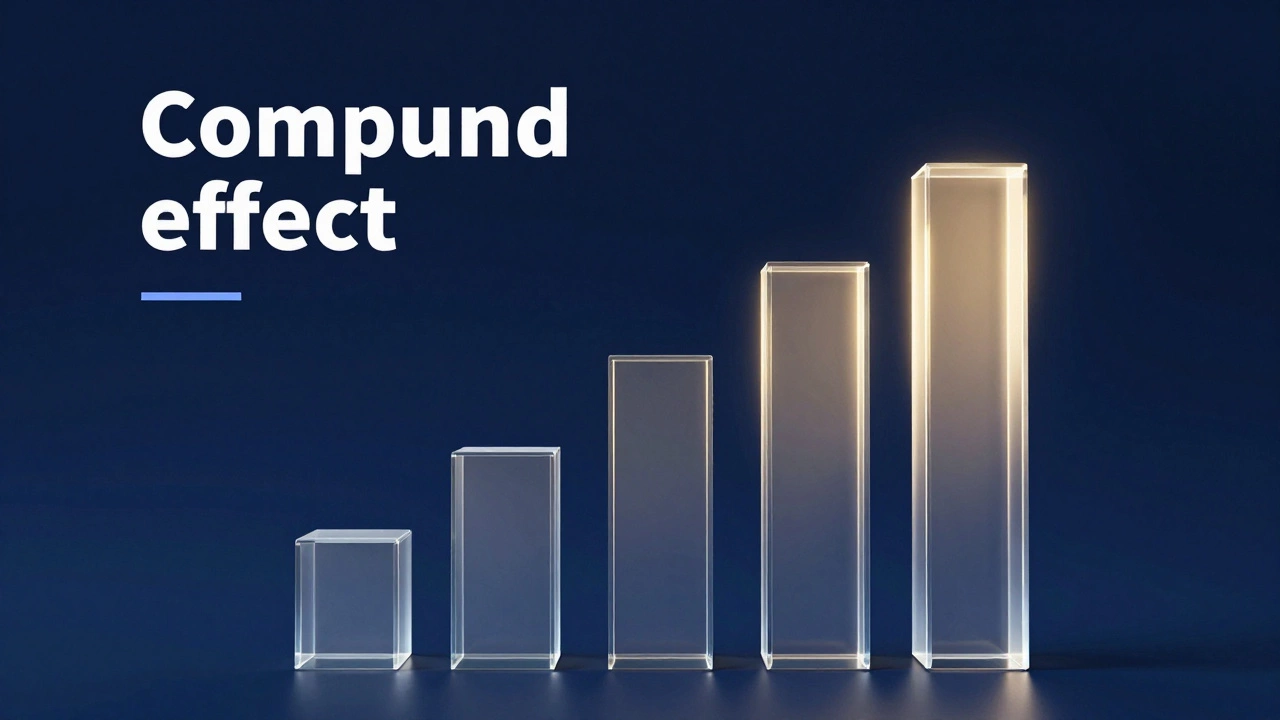
- The Compound Effect: Interest earns interest, meaning your balance grows slightly faster every month.
- Tax Impact: Remember that interest earned is usually taxable income.
The Basic Math: How Interest Works
To figure out your earnings, you need to understand APY is the Annual Percentage Yield, which tells you the total amount of interest you earn on a deposit in one year, including the effect of compounding. Unlike a simple interest rate, APY accounts for how often the bank adds your earned interest back into your balance.
If you have $1,000 at a 4.50% APY, you aren't just getting 4.5% of your initial deposit once at the end of the year. Most banks calculate interest daily and pay it monthly. This means in February, you earn interest on your original $1,000 plus the interest you earned in January. While the difference on $1,000 isn't massive, it adds up over time.
| Account Type | Typical APY | Estimated Annual Interest | Ending Balance |
|---|---|---|---|
| Traditional Savings | 0.01% - 0.40% | $0.10 - $4.00 | $1,000.10 - $1,004.00 |
| Online High-Yield | 4.00% - 5.25% | $40.00 - $52.50 | $1,040.00 - $1,052.50 |
| Short-Term CD | 4.50% - 5.50% | $45.00 - $55.00 | $1,045.00 - $1,055.00 |
Why Your Bank Choice Matters
Not all banks are created equal. Large national banks often have massive overhead costs (think physical branches and thousands of employees), so they offer lower rates. On the other hand, Online Banks are financial institutions that operate without physical branches, allowing them to pass savings to customers through higher interest rates. These institutions usually offer the best APY for a simple savings account.
If you keep your $1,000 in a basic savings account at a "big name" bank, you might literally earn enough to buy a candy bar after a full year. But moving that same money to a high-yield account could pay for a nice dinner out or a few months of a streaming subscription. It's the same $1,000, just working harder in a different environment.
Comparing Savings Options: HYSA vs. CDs
When looking for the most growth for your $1,000, you'll likely choose between a High-Yield Savings Account (HYSA) and a Certificate of Deposit (CD).
An HYSA is flexible. You can put money in or take it out whenever you need it. This makes it perfect for an emergency fund. However, the interest rate is variable. If the Federal Reserve decides to drop interest rates, your bank will likely lower your APY immediately.
A CD is a contract. You agree to leave your $1,000 untouched for a set term-say, 12 months-and in exchange, the bank locks in a specific rate. If you find a 1-year CD at 5.00%, you are guaranteed that return even if market rates crash halfway through the year. The catch? If you take the money out early, you'll pay a penalty that could eat up all the interest you earned.
Hidden Factors That Eat Your Gains
It's not all profit. There are two main things that can shrink your earnings: fees and inflation.
Some accounts come with "maintenance fees" if your balance drops below a certain limit. If your bank charges you $5 a month for having a low balance, you're paying $60 a year. If your $1,000 only earned $40 in interest, you've actually lost $20. Always look for accounts with zero monthly maintenance fees.
Then there is Inflation, which is the rate at which the general level of prices for goods and services rises, eroding purchasing power. If the cost of groceries and rent goes up by 3% this year, but your bank only pays you 0.40%, your $1,000 is technically worth less in terms of what it can actually buy, even though the number in your account went up slightly.

Step-by-Step: Maximizing Your ,000
- Check Your Current Rate: Log into your banking app and look for the "APY" or "Interest Rate." If it's under 1%, you're leaving money on the table.
- Compare Online Options: Look for banks that are FDIC Insured. This means the government guarantees your money up to $250,000 if the bank fails. Never put money in an account that isn't insured.
- Evaluate Your Need for Access: If you might need the $1,000 for a car repair next month, stick with an HYSA. If you're certain you won't touch it for a year, a CD might give you a slightly higher, locked-in rate.
- Automate Your Growth: Once you open the account, set up a small recurring transfer. Even $10 a week turns your $1,000 into a larger engine for compound interest.
Is a savings account the best place for $1,000?
It depends on your goal. If this is your emergency fund, yes, a high-yield savings account is the best balance of safety and growth. If you don't need the money for 5+ years, investing in a low-cost index fund via a brokerage account usually yields higher long-term returns, though it comes with the risk of losing principal.
Do I have to pay taxes on the interest I earn?
Yes. The interest you earn is considered taxable income. Your bank will usually send you a Form 1099-INT at the end of the year if you earned more than $10 in interest. You'll report this on your tax return, and it will be taxed at your normal income tax rate.
What is the difference between simple and compound interest?
Simple interest is calculated only on the principal (the original $1,000). Compound interest is calculated on the principal plus any interest already earned. For example, if you earn $4 the first month, the second month's interest is calculated on $1,004, not just $1,000.
Can I lose money in a savings account?
As long as your bank is FDIC insured (in the US) or covered by similar government schemes elsewhere, your principal is safe. You cannot "lose" your $1,000 due to market crashes. The only way to lose value is through inflation, where the money stays the same but buys fewer things.
How often is interest paid into the account?
Most modern savings accounts calculate interest daily and deposit it into your account once a month. Some CDs pay interest at the very end of the term (at maturity), while others allow you to withdraw the interest monthly.
Next Steps for Your Money
If you've realized your current bank is paying you almost nothing, the first move is to open a new account. You don't have to close your old one; just transfer the $1,000 via an ACH transfer. It usually takes 1-3 business days.
For those who have already maximized their savings, consider looking into a Money Market Account. These often combine the high rates of an HYSA with some check-writing abilities, giving you a bit more flexibility if you're moving larger sums of money frequently.